KUWAIT CITY, 14 July 2003 — Kuwait’s emir yesterday split the posts of crown prince and prime minister for the first time in its 42-year-old democracy in a move seen as heeding repeated calls for domestic reform.
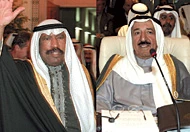
Sheikh Jaber Al-Ahmed Al-Sabah named long-serving foreign minister and half-brother Sheikh Sabah Al-Ahmed as the emirate’s first new premier in 25 years.
Ending days of speculation and years of calls, primarily by the emirate’s liberals, for a separation of the two posts, Sheikh Sabah, 74, replaced 72-year-old Sheikh Saad Al-Abdullah Al-Salem Al-Sabah, who had been prime minister since 1978 but retains the post of crown prince in the reshuffle.
The order asked Sheikh Sabah, who previously served as first deputy premier and has run the Foreign Ministry since 1963, to form a new government.
“It’s quite a relief that the office of prime minister is independent of the heir apparent,” said political analyst and sociologist Khaldun Al-Naqib.
“It will open the road in the future for someone from outside the ruling family to become prime minister,” he told AFP.
“In my opinion, the hesitation to the separation was due mainly to this prospect ... (but) the obstacle has now been removed.”
Sheikh Sabah’s appointment is seen as heralding long-awaited change and the emirate is anxiously awaiting the composition of his new government, which needs to be in place by Parliament’s inaugural session on July 19.
The former Cabinet resigned on July 6, a day after the legislative elections in which the liberals lost most of their seats to Islamist, pro-government and independent candidates.
Sheikh Sabah, a pro-liberal who favors privatization and globalization, is keen on improving Kuwaiti-Arab relations, even with those Arab governments that supported Iraq after it invaded Kuwait in August 1990 and occupied the emirate for seven months.
“The hope is that Sheikh Sabah will be free to form a government of his choosing,” said Naqib. “It will be unfortunate if Sheikh Sabah brings in the old hands, those who have been politically spent.
“We hope he’ll bring in the young and educated, not necessarily technocrats but those independently minded, a departure from the normally obedient and loyal Cabinet members,” Naqib said.
“Let’s hope we have a government with planned determination and not one bogged down by tribal and sectarian considerations.”
Due to health problems, Sheikh Saad had already delegated extensive authority to Sheikh Sabah, who in February 2000 himself had a heart pacemaker operation.
Sheikh Saad underwent colon surgery in early 1997 and has since spent long periods in Britain and the United States for recovery and medical tests.
Each time he has traveled abroad for tests, official statements have been released to underline worries about his health, fueling the debate about the succession.
Sheikh Saad himself confided in early 2000 that his doctors had advised him “not to exhaust himself and to delegate less important tasks to colleagues.”
However, retaining his post as crown prince, Sheikh Saad, a distant cousin of the emir, would automatically become head of state in the event of Sheikh Jaber’s death.
This would be in accordance with a tradition whereby the Al-Jaber branch of the ruling Al-Sabah family, to which the emir and Sheikh Sabah belong, alternates the position of head of state with the Al-Salem branch, represented by Sheikh Saad.
Both branches are descendants of Emir Sheikh Mubarak Al-Sabah, who ruled until 1915.
According to the Kuwaiti constitution, the emir and the crown prince must be descendants of Sheikh Mubarak, who is considered the founding father of modern Kuwait.
The emirate is a member of OPEC and ranks among the world’s largest oil producers with an output of almost two million barrels per day.