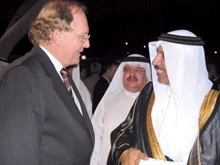
Last September, US Ambassador Robert Jordan had the agreeable task of welcoming the new US Consul General Alfred F. Fonteneau to Dhahran. This September found Fonteneau hosting a farewell reception for Jordan, who will leave his post in October. Nominated by US President George W. Bush on Sept. 12, a day after the tragedies in New York, Washington and Pennsylvania, Jordan was confirmed by the US Senate as ambassador to Saudi Arabia on Oct. 10, 2001. Over the past two years, Jordan represented the American government in Riyadh during some of the most difficult moments in US-Saudi relations.
Prior to coming to Riyadh, Jordan was a practicing attorney and arbitrator, and a senior partner and one of the founding partners of the Dallas office of Baker Botts L.L.P. He had served as personal attorney to President George W. Bush. Arriving in the Kingdom with the American media baying for blood over alleged Saudi involvement in the Sept. 11 attacks, Jordan discovered that he would need to call upon all his considerable skills in debate and persuasion.
The US ambassador faced many tumultuous days during his tenure, with perhaps the worst coming after the May 12, 2003 bombings in Riyadh. To claim that his stay in the Kingdom has been without controversy would be misleading. Described by colleagues as “forceful,” Jordan has sometimes taken difficult stands based on instructions from the American administration and his own convictions.
Introducing Jordan on Sunday night to the hundreds of Saudis and Americans present for the reception at the US Consulate General’s residence, Fonteneau said, “Ambassador Jordan recognizes that the Eastern Province is the driving force behind the Saudi economy and has made it a point to visit this region often. He values the ties the Consulate has with Saudi Aramco and I am proud to note that after more than 50 years, this partnership continues to grow from strength to strength. The relationship between the United States and Saudi Arabia is still strong despite the flood of criticism it received this year. This is due in large part to the efforts of Ambassador Jordan, who went beyond the half-truths, and presented a fair and balanced picture of the US-Saudi relationship to the American people.”
Jordan was greeted with robust applause as he took the podium. He stated that he was grateful for the many friends he had made during his time in Saudi Arabia and thus had come to say, “ma’asalama” to them personally as he was about to “complete his assignment” and depart from the Kingdom.
“Please do not misunderstand me,” Jordan said with emphasis. “This evening is not a ma’asalama in the truest sense of the word for I know I am among friends and I will see many of you again. Therefore, this evening should not be about farewells, but should be about celebrating the friendships that Consul General Fred Fonteneau and I have established during our time together in Saudi Arabia. These friendships are symbolic of the strength of the US-Saudi relationship.”
He continued, “The relationship between the United States and Saudi Arabia is strong and has survived through a difficult year of speculation, misunderstanding and harsh criticism from a variety of fronts. The relationship remains intact despite media attacks on both governments and continues to grow in new and productive ways. We all mourn those who were lost in the May 12 terrorist attacks in Riyadh. The bombings however have proved to only strengthen the relationship between our two countries.”
Jordan claimed that in reality US-Saudi relations have continued to improve as the two governments worked to fight terrorism and ensure security. He did recognize current difficulties such as modifications in the visa system, changing US Congressional views on US-Saudi cooperation and challenges from those fighting against peace and security. However, he felt that all these problems could be overcome by cooperation between those who valued the relationship.
The US ambassador pointed out that Saudi Arabia is still America’s largest two-way trading partner in the Middle East. Last year, two-way trade between the nations totaled nearly $18 billion. The latest trade statistics indicate that in the first six months of 2003, US exports to Saudi Arabia grew five percent and Saudi Arabia became America’s No. 1 export market in the Arab world. Total bilateral trade between the two countries grew by nearly 50 percent during this period, largely due to the increased value of Saudi oil exports to the US.
“Although many of the fundamentals (in the relationship) are sound, we must not forget the challenges that still exist,” said Jordan. “There are real issues that our two nations can try to strive to overcome, such as the challenge of finding mutual agreement on the meaning of tolerance, individual rights and freedom of beliefs. At the same time we must work to correct misunderstandings between our two countries. We must ensure that neither of our countries gives in to the forces of hatred and intolerance.”
In a more somber tone, Jordan added, “I am proud to have worked with our allies, here in Saudi Arabia and throughout the region, in our fight on terror. I would ask that we never forget those who lost their lives to terrorist activities, and those who died fighting to ensure that terror would not win the day.”
After touching on the continuing challenge to help the Iraqis create a free country, Jordan concluded his comments by asserting that, “The United States and Saudi Arabia can find ways to continue to work together to ensure regional peace and stability, and understanding toward all.”
The Saudi dignitaries in the crowd were the first to shake the US ambassador’s hand as he stepped away from the podium.
— Arab News Features 26 September 2003