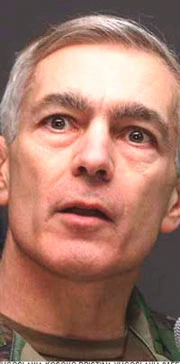
WASHINGTON, 5 October 2003 — What’s the buzz with Gen. Wesley Clark? A journalist from the Wall Street Journal said this week that his wife — also a journalist — had left her job to work for Gen. Wesley Clark. A writer at the Los Angeles Times said yesterday he didn’t like him when he was a general and didn’t like him now as a presidential candidate. Why? “Because he’s arrogant.” But some think that’s what’s needed for a man to be called a ‘perfect model officer,’ and be a presidential contender.
So, what’s the deal with the general? To get an idea, this correspondent attended yesterday’s Military Reporters & Editors’ annual conference — the largest post-war gathering of journalists who participated in the US military’s embed program — where Gen. Wesley Clark was keynote speaker.
Facing the audience of reporters, Gen. Clark recalled the first journalist he met over 20 years ago. “It was winter, in the middle of a snowstorm, and I put him in a tent without tent.” He paused: “I never liked the way that story turned out.”
It’s clear he’s learned a few things since then when dealing with the media. When he accepted to speak at MRE, Clark said he was not a presidential candidate, but added this was now his chance to clear up questions as to why someone with a full career in the US Armed Forces “would do this to himself and his party?”
Clark, a retired general who served 3 years under now Secretary of State Colin Powell, said he still believes in his patriotic duty. “The reason why — is because I see an administration that’s taken this country badly off course, has shown poor planning for post-conflict Iraq, is costing America hundreds of casualties and billion of dollars. This is an administration that’s lost confidence abroad, and increasingly, at home.
“The war against Al-Qaeda was disrupted by the war in Iraq — a war that this administration chose to fight, but ultimately did not have to fight” said Clark, who throughout his speech voiced grave concern over US relations with the rest of the world. And in an irony of ironies, he hails from Little Rock, Arkansas.
“We’re in a crisis with our relations with the rest of the world. Today is a time when we need our allies, but resentment of America has never been higher.”
“And the fact that none of our allies at the UN have committed troops or money for the war in Iraq was a humiliating blow for the US,” said Clark. “George Bush has forgotten what he said earlier in his career: ‘To be relied on when they’re needed, our allies must be respected.’ They are not.”
“We have refused to share in the decision making with them, and now our allies are refusing to share in the cost. We will not be able to work on the problems in the Middle East, Korea, Iran, and terrorism, unless we share the burden with our allies.”
Clark wished he could say the “dire” state of relations with our allies is an accident, “but it’s not, it a direct consequence of this administration’s decision to turn its back on our allies, rupturing 60 years of good relations throughout the world,” said the former NATO commander, who was a Rhodes scholar and graduated first in his class at West Point.
Before the Iraq war, Clark said “leaders in the Armed Forces privately warned me about what was going to happen in this war, but they obeyed the orders of the president of the United States.” Many of the former embeds he addressed had heard the same doubts.
“Nothing could be a more serious violation of public trust than to conscientiously make a decision for a war by using false pretenses. We must regain the trust of our citizens and allies,” he said.
“I’ve given my life to the service of this country, I couldn’t stand by and watch the values and institutions I cherish being hurt and damaged; nor watch the allies I respect being trashed; or watch the men and women I cherish sent to a war that was fundamentally distracting from our real imperatives,” said the former speechwriter and general executive officer to former Gen. Al Haig.
Asked if he agreed with Sen. Ted Kennedy’s statement this week that the war in Iraq was “a fraud,” the former four-star general said he hadn’t seen the intelligence reports. “I accepted the fact that Saddam Hussein had some residue weapon materials left over from the Gulf War, but I never saw any proof that he had it. But even so, I didn’t see an imminent threat from Iraq.
“I’ve heard people in this administration say that we need to reshape the Middle East. When I heard it, I hoped it was scuttlebutt, but now I’m afraid it’s so.” Asked if Secretary of Defense Donald Rumsfeld should resign, the General answered with a quick: “Yes, sir!”
Questioned on if he thought this administration targeted Al-Jazeera in Afghanistan and Iraq, Clark said: “There is a legitimate difference of opinion between the way we see the problems in the Middle East and the Islamic perspective. One of the most important things we must understand is their perspective and their view of the facts. And, I’m generally against the muzzling of the media.”