
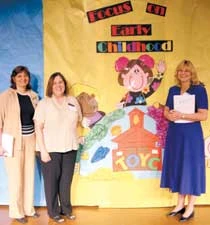
“Focus on Early Childhood” was the theme of the 5th Teachers of Young Children (TOYC) Conference held yesterday at the Dhahran International Schools Group (ISG) Campus. The event attracted 300 attendees, most from the Eastern Province, but also some from Jeddah, Riyadh and Bahrain. The full-day conference included a keynote speaker and four workshops for the group of educators interested in teaching those children eight years old and under.
“You are to be congratulated on your dedication to teaching,” said Fred Bowen, ISG superintendent. “The most challenging teaching in any school takes place in the classrooms filled with young children. I admire you for your patience, understanding and stamina.”
TOYC was founded by teachers Len Hatch, Carol Hudson and Linda Amin. Amin is currently the president of the organization. Hudson, a past president of the group had the bittersweet task at the conference of announcing a scholarship fund to honor Hatch, who died last summer.
“We always wanted to give a scholarship to enable us to send a teacher annually to a conference for teachers of young children,” said Hudson. “It is sad that we are achieving this goal only after the passing of such a beloved teacher as Len Hatch. We will be accepting applications for the scholarship from any member of TOYC. The scholarship covers expenses for the Early Childhood Conference in Dubai in January 2004. The teacher selected to attend the conference will then present what he or she learned at the event to all the TOYC members at our April 2004 conference.”
The TOYC conference held yesterday was originally planned for April 2003, but it had to be rescheduled after the regional unease last spring. Conference Chairman Joanne Hegazi thanked Bruce Hudson, principal of the ISG Dhahran Elementary/Middle School for standing by and supporting TOYC throughout all the difficulties of the last months. The attendees were clearly pleased that the event had finally taken place.
“I am one of 11 teachers who has come over to the Kingdom for the day from Al-Raja School in Bahrain to attend this conference,” said Najla Al-Shehabi, a first grade teacher.
“All of us are teaching in grades one to three and we are really searching for new ideas to help our students learn. We have some special-needs children mixed in with the general population and we hope to receive some advice on the best ways to support these youngsters, too.”
“Teaching early learners is without a doubt a challenge,” she continued. “I have to know how to speak to them, explaining everything with sounds and pictures to help them understand the world around them. I love my work but I am exhausted at the end of each day. My young students are full of energy and I must know all the latest techniques to keep them engaged in learning.”
The highlight of the conference was the presentation “From Toys to Technology: Considerations for the 21st Century,” by keynote speaker, education consultant Ellen Alquist. The presentation was designed to help teachers of young children decide how, when and what types of technology to introduce into their classrooms.
“Think about the technology,” said Alquist. “Is it developmentally appropriate? Is it consistent with how a child develops and learns and is it within the current developmental strategy? Will the activity benefit the child or will it replace some other more meaningful learning activity?”
Alquist explained that young children have come to see technologies such as computers, televisions and camcorders as a normal part of everyday life. Thus, there is no reason to exclude them from the classroom. In fact bringing technology into the classroom in appropriate ways can greatly enrich the learning experience for young students. Having worked with computers and tots since 1978, Alquist pointed out that there was nothing to fear from letting children use a computer.
“Short of taking a bucket of water and dumping it on the machine, children can’t hurt computers. So letting them play with computers is fine,” said Alquist. “The key here is in letting the child use the mouse and the keyboard or other input device. It’s all right for the teacher or parent to give directions and point, but the adult should never be the one touching the keyboard or mouse. It’s up to the child to learn to use the machine with direction and it can be hard for an adult to learn to keep hands off. It’s also always important to remember that other toys are as important as computers.”
Alquist advised that young children should use the computer in groups of two or three so they interact with both the software and each other. Teachers should thoroughly test software before introducing it into the classroom, even making mistakes similar to those that their students might make so they will know how the program reacts under all circumstances.
Computers can expand children’s horizons by allowing them to travel virtually through time and space. Computers are also infinitely patient when a child is learning new concepts. The young student can make mistakes again and again or try infinite combinations of words, numbers or ideas, and the computer won’t mind.
“We hope that the teachers here with us today will find value in the new ideas being presented,” said Hegazi.
“Teachers of young children must love learning and be willing to change their teaching techniques everyday to suit their eager audience. I’ve been teaching for eleven years in Saudi Arabia and no two years have ever been the same. I do have one important message that I would like to relate to the community. Our children are facing many challenges and perhaps the greatest challenge for them is finding someone to give them time. As early child educators we still pick up the book and sit down with the children and read to them. Our classrooms are interactive and exciting. We need parental support to reinforce the love of learning that young children experience in our classrooms everyday.”
— Arab News Features 17 October 2003