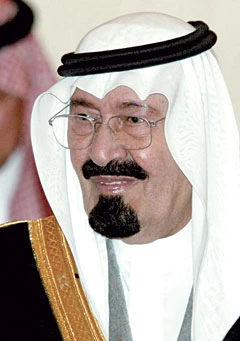
PUTRAJAYA, Malaysia, 18 October 2003 — Crown Prince Abdullah, deputy premier and commander of the National Guard, yesterday denounced extremists as deviants from the Islamic faith and called for an intellectual campaign to counter creeping militancy.
Addressing the OIC summit, which concluded here yesterday, the crown prince said the Muslim community’s crisis was partly intellectual in nature. This emanated from “excessiveness, leading to extremism, which turns them to terrorism.” Stressing that Islam is a religion of kindness, mercy and tolerance, Prince Abdullah said a “minority” of deviant terrorists should not be allowed to tarnish the image of Islam.
“The bullets that kill women and children, terrorize those secure in their safety and destroy innocent communities do not come from rifles but from deviant thoughts and misguided interpretations of our great religion and its noble message,” he said.
More than 30 heads of state and government turned up at the largest summit of the 57-member Organization of the Islamic Conference, which called for a faster transition of power in Iraq from US occupying forces to an Iraqi government. The final communiqué at the end of the two-day summit pledged to fight terrorism but rejected “selectivity and duplicity of standards in combating terrorism and all attempts to associate terrorism with a particular religion or culture.”
It called for the signing of a convention to distinguish between terrorism and the legitimate struggle for the right to self-determination of people living under occupation or foreign domination.
The communiqué “condemned the perpetration by Israel of crimes, murder, detention, destruction of homes, demolition of infrastructure and imposition of collective sanctions on the Palestinian people”.
In his keynote address, Prince Abdullah urged the OIC to strengthen institutions to help counter rising extremism among Muslim youth and called for empowering the Islamic Jurisprudence Council.
He urged Muslim leaders to work bravely and wisely to tackle the economic and political problems in their countries. He also urged them to promote inter-OIC trade and enhance the financial resources of the Islamic Development Bank to finance trade among the Muslim countries.
“Saudi Arabia will be the first country that extends financial support for encouraging trade exchange among the Muslim countries,” the crown prince said. “The Kingdom will contact IDB governors to discuss details of this support,” he said.
The crown prince proposed formation of a five-member Islamic Committee of Peace to tackle the pending problems among the Muslim countries, as well as the problems between Muslims and others.
He urged the summit to extend moral and material support to the Palestinians to enable them regain their legitimate rights, notably the right to establishing their independent state with Jerusalem as its capital.
“We should extend unwavering support to Iraq so as to enable it to get through its present ordeal, overcome its difficulties and return as a free and independent Arab and Muslim country, and to enable its people to live peacefully and in cooperation and harmony with their neighbors,” he said.
In their final communiqué, the OIC leaders condemned terrorism “in all its forms” and issued a separate declaration condemning Israel’s airstrike on OIC-member Syria earlier this month as a “blatant violation” of international law.
The leaders stressed the right of the people of Iraq to “determine their own political future, to have full control over its natural resources and to establish a broad-based and fully representative government.”
They also stressed “the need to accelerate the restoration of the full sovereignty of Iraq.” But the communiqué did not include a call that was in an earlier draft approved by foreign ministers and called for the United Nations to take a leading role in Iraq and for US troops to withdraw as soon as possible.
The Iraqi Governing Council, which attended the summit over initial objections from some countries, had objected to the earlier draft, saying the OIC should accept that US-led troops would be in Iraq for some time, and that the Iraqi government wanted to take over directly from the occupiers, not from a UN-led administration.
“To put a timeframe for the withdrawal of forces, there should be consultation with the Iraqis themselves,” Iyad Alawi, the current holder of the council’s rotating leadership, said. “We don’t have an army now, we don’t have a police force, so withdrawal of forces means disaster for Iraq.”
In their statement on Syria, the leaders said the Israeli airstrike, and the threat of similar strikes in the future, “constitute a serious escalation in the Middle East that endangers both regional and international peace and security, aggravates the deteriorating condition in the region and leads to dire consequences.”