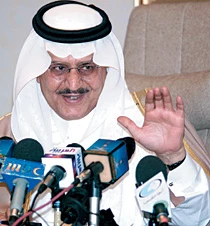
JEDDAH, 6 November 2003 — Interior Minister Prince Naif has reiterated Saudi Arabia’s commitment to political reforms but insisted that the absence of democracy was not the reason for terrorism. “It is not permissible to cite the absence of democracy in order to justify the practices of some terrorist groups,” the minister told the pan-Arab Al-Hayat Arabic daily. “Otherwise, it would mean that terrorism is a form of democratic expression, whereas terrorists are hostile to democracy in the first place,” he pointed out. “Violence in all its forms has occurred, and occurs, in Western democracies so how can we say that terrorism results from a lack of democracy?” the prince asked.
Prince Naif insisted that political reforms must be compatible with Islamic tenets. “If democracy means justice, equality and freedom, then we are all democrats,” he added. “We do not oppose anything that is in the citizens’ interests provided it does not contravene the principles of Shariah,” which underpins the Kingdom’s social and legal system, he said.
Saudi Arabia announced last month it would hold its first elections within a year to elect half the members of new municipal councils. Semi-official reports have since said the elections would be held within three years to fill one-third of the 120 seats of the Shoura Council and that half the members of regional councils would be elected within two years.
“The Kingdom was founded on reforms. None of us can say that he is against reforms but some people use reform as a means to achieve their vested interests which may oppose national interests and this is not logical,” Prince Naif said. “Others see reform as abandoning our Islamic values and foundations but this too is rejected. And it is also unacceptable for some to believe that reform is about resisting development and confronting others,” he explained. “Democracy is an attractive word. But when we come to its actual application, we see something totally different. We are a nation with its own culture and methods which do not go against the teachings of Shariah,” he said.
Prince Naif said women’s rights are protected in the Kingdom. “Women have been given their full rights as mothers, sisters, wives, daughters, citizens and workers. The rights enjoyed by women in the Kingdom are much more than in other societies,” he said. The participation of women in the Shoura or Cabinet is to be decided in accordance with the teachings of Shariah, he added.
Prince Naif said the crackdown on suspected militants, stepped up since the May suicide bombings in Riyadh that left 35 people dead, had been “successful and fruitful.” The interior minister rejected accusations of abuses by human rights groups. “Although we don’t claim perfection, we are at the forefront of those who defend human rights,” he said. Prince Naif denounced the double standards of human rights organizations. “Why don’t they raise their voice against rights violations in Palestine?” he asked. Allegations of human rights violations would not hamper the Kingdom’s accession to the World Trade Organization (WTO), he said. Saudi Arabia has already signed a major WTO deal with the European Union. Riyadh was officially informed last month that it was headed for WTO membership early next year.
Prince Naif rejected attempts to equate Islam with terrorism, saying such attempts were “a strategic choice by those seeking to harm Islam, which is against terrorism.” He said the irresponsible behavior of some Muslims had reinforced this inaccurate idea. He said, however, that the wrongdoings of some individuals should not be taken as justification to tarnish Islam. “Only the person who commits a crime is pronounced guilty in law and custom, not others,” he pointed out.
He said there was a “good level of coordination” between Saudi Arabia and the United States in the anti-terror campaign, and he described ties between the two countries as “historic.”
He said Saudi border guards were “permanently monitoring” the Kingdom’s borders with Iraq to prevent any infiltration by presumed terrorists into the war-torn Arab country. He said there was coordination with Yemen to prevent the smuggling of weapons and drugs into the Kingdom. “It is not impossible” since the length of the Saudi-Yemen border is some 1,000 kilometers, he said.