
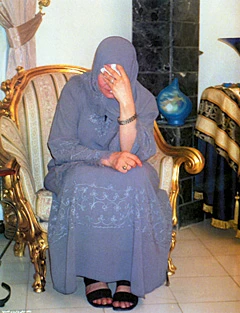
JEDDAH, 28 November 2003 — Nahed met her first husband when he came to Morocco and showered her and her family with gifts. Against such generosity, the age difference mattered little — or so she thought. Like any girl, she says, she was simply happy to get married.
When the newly-weds went to Saudi Arabia, Nahed found herself living in the lap of luxury. The years passed and they had twin daughters, Hatoon and Haifa, followed by another daughter, Hadia.
The only fly in Nahed’s ointment was her husband’s daughters by his first wife. “They disliked the idea of the marriage because of the age gap, and they often interfered in our lives,” Nahed said. “Fearing for myself and for my daughters’ future I approached my husband with the idea of drawing up a document for custody of my daughters should he die.” Knowing how his older daughters felt about his second wife, Muhammad agreed, and Nahed says they registered the document in court.
Then Muhammad’s eldest daughter found out and threatened to ruin their marriage, which indeed she proceeded to do. “Through conspiracy and deceit she was able to damage my standing with her father, and he annulled the document.”
Discord led to divorce, and Nahed returned to her father’s house in Morocco. She was approached by another Saudi, who asked her to marry him and promised to help her acquire Saudi nationality and custody of her daughters.
“When I came back to Saudi Arabia I asked to see my daughters, and I also wanted custody of the youngest who was only two at the time of the divorce. My ex-husband had no problem with that. My youngest daughter remained in my custody until she was five years old. Before my ex-husband’s death I visited my daughters — and they me — constantly.” But then Nahed went to Morocco to visit her mother, who was ill, along with her brother, whom her husband had employed to oversee her personal affairs. While in Morocco she heard the news that her ex-husband has passed away. She phoned his family to offer her condolences and was back in Saudi Arabia four days after the funeral.
“I tried to call my daughters to console them and was surprised to hear their eldest sister, Maram, say that I will not be allowed to see or call them. I pleaded with them, but to no avail. She said that if I wanted to see them I would have to go to the courts.”
According to Nahed, Maram claims only to be following instructions her late father left in his will. “I dare her to show me the will. My ex-husband never stopped me from seeing our daughters whenever I wanted.”
During this time Nahed says she learned that her eldest daughter had been married off without her consent and on condition that mother and daughter were not allowed to see each other. Her twin sister was taken out of school to serve in the house and was being subjected to torture and beatings by Maram, her husband and their sons. Nahed decided to go to a lawyer.
But Maram tells a different story. After the death of her father, Maram says, the family got together and she and her sisters expressed their wish to have custody of the girls in accordance with their father’s wishes. “We agreed that they would be better off at my house, especially since their mother had gotten married. “I told Nahed in the presence of her daughters that she was free to visit them at my house, but she refused. She wanted them to go to her house, and I wouldn’t have it,” she says.
“As for her eldest daughter’s marriage — it took place when the mother was away. We thought the man was suitable and my sister agreed to the marriage. I treat my sisters well and they prefer to live with us. All my family can bear witness to this.”
The law is clear on the issue, says lawyer Naif Mohamad Fawzi Yamani. Custody is the mother or maternal grandmother’s right even if the father is alive. If some cases, the mother has the sole right to custody.
“On the other hand, the girls cannot continue to live in their brother-in-law’s house, because he is not considered a mahram or legal guardian: If his wife dies or he divorces her he could then marry either one of the girls.”
“Nahed’s new husband, on the other hand, does qualify as a mahram because she has had children by him, so the girls are his children’s sisters,” Yamani says.