
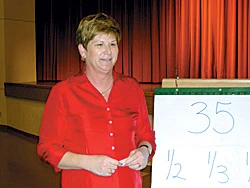
“Parents talk to their children about many things, but they don’t talk about math. At the dinner table have you ever had a conversation about rectangles?” asked Education Consultant Ellen Alquist.
“Why not? Math is a very important subject. It allows us to describe our world and we all need to be fluent in mathematics.”
Alquist was making a presentation to parents of children attending the Dhahran Elementary/Middle School, part of the Kingdom’s International Schools Group (ISG). According to Bruce Hudson, school principal, three years ago all ISG schools implemented a new program for learning mathematics. As a part of this new program, parents are invited to attend a seminar that will provide them with the skills to help their children with math homework. By being walked through a typical math lesson, parents are better able to understand the learning methods emphasized in their children’s math classes.
The ISG schools are following a research-based curriculum called “Everyday Mathematics,” which was developed by the University of Chicago School Mathematics Project (UCSMP). Based on the findings from this ongoing project, several basic principles have been established to guide the development of Everyday Mathematics. These principles are:
• Students acquire knowledge and skills, and develop an understanding of mathematics from their own experience. Mathematics is more meaningful when it is rooted in real life contexts and situations, and when children are given the opportunity to become actively involved in learning.
• Children begin school with more mathematical knowledge and intuition than previously believed. A Kindergarten through 6th Grade curriculum should build on this intuitive and concrete foundation, gradually helping children gain an understanding of the abstract and symbolic.
• Teachers, and their ability to provide excellent instruction, are the key factors in the success of any math program.
There are a number of features that distinguish the Everyday Mathematics curriculum. These include:
Real-life Problem Solving: Everyday Mathematics emphasizes the application of mathematics to real-world situations. Numbers, skills and mathematical concepts are not presented in isolation, but are linked to situations and contexts that are relevant to everyday lives.
Balanced Instruction: Each Everyday Mathematics lesson includes time for whole-group instruction as well as small— group, partner or individual activities. These activities balance teacher-directed instruction with opportunities for open-ended, hands-on explorations, long-term projects and on-going practice.
Multiple Methods for Basic Skills Practice: Everyday Mathematics provides numerous methods for basic skills practice and review. These include written and choral fact drills, mental math routines, practice with fact triangles (flash cards of fact families), daily sets of review problems called math boxes, homework, timed tests and a wide variety of math games.
Emphasis on Communication: Throughout the Everyday Mathematics curriculum students are encouraged to explain and discuss their mathematical thinking, in their own words. Opportunities to verbalize their thoughts and strategies give children the chance to clarify their thinking and gain insights from others.
Enhanced Home/School Partnerships: For grades 1-3, daily Home Links provide opportunities for family members to participate in the students‚ mathematical learning. Study Links are provided for most lessons in grades 4-6, and all grades include periodic letters to help keep parents informed about their children’s experience with Everyday Mathematics.
Appropriate Use of Technology: Everyday Mathematics teaches students how to use technology appropriately. The curriculum includes many activities in which learning is extended and enhanced through the use of calculators. At the same time, all activities in which calculators would function simply as crutches for basic computation are clearly marked with a “No calculator” sign.
During her presentation, Alquist demonstrated the idea that doing mathematics is not about solving problems the “right” way. On a board in front of the group of parents, she wrote a basic math problem involving numbers made up of double digits. Everyone at the presentation was able to easily do the required calculation. Interestingly though, the parents used many different methods to solve the problem. This was because the adults understood mathematical concepts such as the relationship between numbers and place value. Unfortunately children often are not taught to think of concepts in mathematics. Instead, there is frequently an effort to turn students into calculators.
“Math is conceptual, it is not just about numbers. Machines can do computations better than humans, so why all the focus on basic calculation ability?” Alquist asked. “In the world there are 24 different algorithms for subtraction, but used in a problem-solving context they all come out the same. Students often think that they must do a problem in the one way taught in class. This can be very frustrating. Students need to understand math concepts first. Then they will develop a way to solve the problem.”
Alquist spoke about the idea that mathematics is not a subject created for the elite in our world.
“Everyone can do math,” she said. “Every attempt must be made to invite students to join the ‘math club.’ Mathematics is really a language. We must be able to read it and write it. As technology moves forward, mathematics is becoming the universal language and it is increasingly important in our world.”
One essential concept that Alquist urged parents to take to heart is that math is not a subject that can be memorized. In fact, she pointed out that the worst way to learn anything is through memorization. If children forget what they learn through memorization, they have no way to go back and reconstruct it.
However, if students understand a dilemma in multiple ways, then they can use their own creativity to find a way to reach a solution. This is true-life learning.
“I have met children who are frustrated and frightened by mathematics, but I never met a child who wanted me to think that he was stupid,” emphasized Alquist. “When parents are discussing mathematics problems with their children it is important that they explain the ideas presented by the problems and understand that their way isn’t the only right way to solve the problem. When a child does solve a problem the parent should ask questions such as ‘Why do you think this is the right answer?’ ‘Can you explain how you got this answer?’ Children must learn each math concept thoroughly so that it doesn’t have to be revisited again in future instruction. In this way they can create a mathematics foundation to build on, learn new things and keep moving on to higher levels of understanding.”