NEW DELHI, 5 December 2003 — India’s ruling Hindu party yesterday swept to power in three out of four states that went to the polls early this week. The victory of the Bharatiya Janata Party in Madhya Pradesh, Rajasthan and Chattisgarh — all currently ruled by the opposition Congress party — was all the more stunning in the absence of the party’s anti-Pakistan war cry and demand for a Hindu temple in Ayodhya in pre-election campaigns. Congress retained only Delhi.
However, the BJP said the gains would not tempt it into an early national election.
“At no point of time (have) we thought of advancing the elections,” Pramod Mahajan said after Prime Minister Atal Behari Vajpayee met party leaders. “The PM wants to complete the term.” The ruling coalition’s term ends in October 2004.
Counting continued late into the night.
While Congress expected a 3-1 verdict in its favor, it turned out to be the exact opposite.
The BJP’s greatest victory was in Madhya Pradesh, where it bagged 173 of the assembly’s 230 seats and was poised to finish with a record majority under the leadership of Uma Bharati. Outgoing Chief Minister Digvijay Singh admitted candidly: “There was a wave against my government. People have voted for a change.” Singh has ruled Madhya Pradesh for a decade.
The BJP also made history in Rajasthan by crossing the 100-mark for the first time in the campaign for change led by Vasundhara Raje Scindia, a member of the erstwhile princely family of Gwalior.
The BJP had won 120 of Rajasthan’s 200 seats, leaving Congress a distant second with just 58 seats.
In Chhattisgarh, the BJP won 50 seats in the 90-member assembly while Congress was left with only 37.
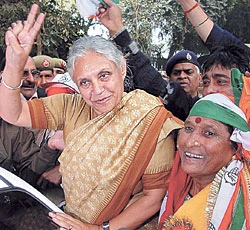
In Delhi, Congress registered its lone victory with 47 seats against the BJP’s 20 in the 70-seat assembly.
The overall outcome takes the BJP’s national tally to seven states, bringing it closer to Congress as the latter’s kitty whittled down to 11.
It was a hard blow to Congress, whose Italian-born leader, Sonia Gandhi, is struggling to win acceptance as an alternative prime minister, and who trails Vajpayee in opinion polls.
“We did not gauge the extent of this defeat,” Congress leader Ambika Soni said. “It’s important for us to... pinpoint where we went wrong, why we were not able to gauge this kind of setback.”
Analysts say the results highlight an emerging force — swinging voters choosing performance over traditional caste and other loyalties, who, though small, can still influence outcomes.
“There’s a major shift taking place in Indian voters, from traditionally inherited patterns of loyalty to performance-oriented patterns of loyalty,” analyst and columnist Prem Shankar Jha said.
Financial markets are likely to see the gains as a strong plus for the BJP, bolstering its economic reform program. “The pro-reformists within the BJP will get the upper hand now,” said Sanjay Sachdev, of Principal Mutual Fund.
The BJP won the last major state election, in riot-scarred Gujarat a year ago this month, with a hard-line Hindu campaign that many feared would be repeated. Instead, it focused on economic management, good governance and targeting pivotal seats, which senior leaders say will also form the basis of its federal re-election strategy.
Aside from Vajpayee’s public commitment to a full term, analysts highlight other obstacles to an early poll.
The BJP is in disarray in India’s most populous state, Uttar Pradesh, which is its power base and accounts for 80 of the 545 members of Parliament — more than the combined 72 seats from the four states decided in Monday’s elections.
The large southern state of Andhra Pradesh, ruled by a key BJP ally, will also go to the polls early in the new year.
Vajpayee is also preoccupied by a delicate peace process with neighbor and traditional rival Pakistan, which he is due to visit for a summit of regional leaders in January.
— Additional input from agencies
—