
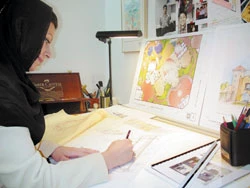
Nadia Bakhurji is the president of her own firm of interior architects, designing among other projects the interiors of palaces for the royal family and ballrooms for major hotels. She told the Review about her rise to prominence in an environment where women still face a lot of obstacles.
Arab News: You graduated in interior design from King Faisal University in Dammam. Is that a popular major for Saudi women?
Nadia Bakhurji: In 1983, when I started out, it was a new course and we were only the second group to be admitted. It ran very well for five years and then they closed it down for a period. But at the time it was very popular - they had to turn away a lot of girls.
Q: As a Saudi woman who is the president of a firm of interior designers, do you consider yourself lucky?
A: I think I had excellent opportunities and I managed to get the best of two. I was brought up in the West - in England - and went to university here in Saudi Arabia, I think it was a very positive combination. And yes, I feel privileged that I managed to attain a very high standard education and we were very fortunate when we went to the university because we had excellent people teaching us. The curriculum was very strong.
When I graduated it never occurred to me that working would be difficult or there would be a lot of obstacles. All I could see was that I wanted to practice what I studied and I wanted to do it here in Saudi Arabia.
Q: What exactly does the company do?
A: Our specialty is design and concept design. We are very strong in concept design. We have two departments - architecture and interior design. There is also this melting point in the middle where architecture and interior design mix, where you have a project with a client that requires both ends of the spectrum.
When it comes to architecture projects we design all types of buildings, commercial, residential, corporate. We've won several design competitions, which made me very proud.
We started as an interior design firm, but we now do architecture too.
Q: Most jobs for women in Saudi Arabia are in the medical or teaching fields. What made you choose interior design?
A: I was an artist. That's what I loved. I loved to paint. I loved to draw. As a child that was my biggest dream: to be an artist or a fashion designer. But at the time my father wanted me to study medicine. In the end when he came back to Saudi Arabia - because he was doing his Ph.D. in England - King Faisal opened this opportunity for girls - the college of architecture and planning, and I joined.
Q: Did the nightmare of being jobless ever cross your mind?
A: I was never worried for a moment. As soon as I moved to Riyadh I was social I made lot of friends. One of my friends knew a girl who was an architect, and said she needs some assistance. I went to see her and I worked with her for three months. And when I saw what she was doing I realized that I could do the same. I started from home immediately.
I started in 1989 - I got a very good contract with AT&T.
Q: Being a female president of a company in a male-dominated society, did you face any hardship?
A: In the beginning I had a lot of big dreams and I thought I would be able to associate with a local firm, and I approached a few. Obviously they wouldn't hire anyone full time, because they cannot hire a female staff - because of the regulations they cannot have mixed environments. I thought, okay, fair enough, this is Saudi Arabia. So I said to them, "how about working together, I'll be from my office." So some were interested and quite positive. But the majority said, "Well, we're already working with firms from abroad, Italy, France, England." And this went on and on.
Q: Do men here have a lot of problems dealing with a female interior architect?
A: In general, no. I found most of the people I dealt with very professional. When you're dealing with other architects, other engineers, other officers, business is business. They expect you to deliver. In the beginning obviously, breaking the ice - "Can a woman handle this job?" - you have to gain confidence.
But I had a couple of scary experiences when I first started, with potential clients. And not necessarily Saudis: foreigners living in Saudi Arabia in positions you have to deal with because they represent a client. Some of them can be very discriminating. It's a man thing, not a just a Saudi thing.
This taught me to develop a very professional personality.
Not tough and aggressive and masculine, because I don't believe in that. But to be very direct about what I'm doing and not to take any nonsense from anyone.
Q: What would you say to those who think that men and women working in a mixed environment would be a threat to our culture or traditions?
A: I believe that in order for a nation to progress, the men and women of that society must work hand in hand. And it's very difficult to do if you have all these obstacles. I know a lot of corporations that have tried to hire women and to support women and they spent money establishing departments for these girls. In the end they had to close them down and put those women back out simply because of the restrictions and difficulties. A lot of corporations will say, "Well, I don't want to invest all that money duplicating the premises, duplicating the equipment, duplicating my resources to separate the men from the women - it's a huge expense.
I haven't had any Saudi girls working with me. Not because I had the opportunity and didn't want to, but because none of them actually came forward for a job. And frankly, I had to hire a lot of foreigners because I was looking for professionalism.