BAM, Iran, 28 December 2003 — Overwhelmed relief crews picked through entire city blocks of rubble in search for survivors and bodies a day after an earthquake ruined this southeast Iranian city. As estimates of the fatalities reached tens of thousands, the government appealed for international help and waived visas for foreign relief workers.
The scope of the tragedy was so vast that a reliable death toll was impossible to give. The Interior Ministry estimated 20,000 dead Saturday, but two leading rescue officials said the final toll from Friday’s magnitude 6.3 quake could be double that figure.
Rescue workers recovered 150 people alive yesterday, Revolutionary Guards officer Masoud Amiri said. The survivors included a baby under 12 months of age whose condition was “stable,” he added.
Twenty people were pulled from the ruins after being located by sniffer dogs provided by the Iranian Army or European donors, the official IRNA news agency reported.
Iranian reluctance to allow foreign rescue teams to bring the animals delayed international relief efforts after quakes in Iran in 1990 and again last year. But since the mid-1990s a growing number of Iranian theologians have justified the use of sniffer dogs to save human life and on Friday the Interior Ministry specifically appealed for international donors to send the animals.
One man interrupted Interior Minister Abdolvahed Mousavi Lari as he spoke to reporters in Bam. “My father is under the rubble,” the man said, with tears rolling down his face. “I’ve been asking for help since yesterday, but nobody has come to help me. Please help me. I want my father alive.”
Lari tried to calm the man down and assigned an aide to see that he got assistance.
Workers dug with shovels and even their bare hands to extricate bodies and possible survivors from the remains of flattened buildings in this city, whose population was about 80,000 until the quake. In some parts of the city, bulldozers were moving the rubble.
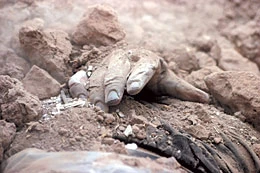
A man with white turban and graying beard dug into and lifted rubble from the remains of his house. His family was buried underneath. He and four friends worked with hand and shovel. When a hand of his teenage daughter appeared, he fainted. Eventually, the bodies of his daughter, wife and two sons were brought out.
“The disaster is far too huge for us to meet all of our needs,” President Mohammad Khatami said, declaring three days of mourning.
The government opened Iranian airspace for all planes carrying aid or relief workers, and said they would be directed to Kerman or Bam airports. It also waived visas for foreign relief personnel.
Many countries responded. Saudi Arabia sent five planeloads of relief supplies including foodstuffs, medicine, blankets and tents. It also sent a medical team including doctors, paramedics and first-aid experts.
Planes from Britain, the Czech Republic, Germany, Russia, Switzerland and Turkey also arrived. Italy and countries as far apart as South Africa and South Korea said they would fly in equipment, aid and workers.
US President George W. Bush has offered to assist Iran, putting aside political differences between the two countries which have no diplomatic relations. A squad of 70 Californian firefighters specialized in rescue work prepared to fly to Iran.
Thousands of residents spent Friday night outdoors, sleeping under blankets in temperatures close to freezing point. A few hundred slept in tents erected by relief workers.
The only smiles in Bam were on the faces of a movie poster on the wall of a cinema. The cinema was ruined.