ISLAMABAD, 4 January 2004 — A state welcome was accorded yesterday to Indian Prime Minister Atal Behari Vajpayee as he arrived in Islamabad on a historic visit for the SAARC summit, his first visit to Pakistan since the nuclear rivals came to the brink of war in 2002.
Vajpayee, 79, sees the summit as a crucial chance to propel what he has twice heralded as his “final” bid for peace, which he initiated in April with a “hand of friendship” offer to Pakistan. The neighbors came to the brink of a feared nuclear war in 2002, following a deadly attack on India’s Parliament in December 2001.
The 12th summit of the South Asian Association for Regional Co-operation (SAARC) summit, opening today for three days, could provide the opportunity for Vajpayee and Pakistani leaders to hold their first talks since July 2001.
Pakistan is pressing for a bilateral meeting, and Prime Minister Zafarullah Jamali told Saturday’s The News daily that he expected a “structured Indo-Pak” summit during Vajpayee’s visit.
Vajpayee ruled out bilateral talks before departing from New Delhi, telling Indian state television: “There will be no bilateral talks. We want to give all our energy to making the SAARC talks successful.”
But in a formal statement issued before traveling to Pakistan, Vajpayee said he intended to “interact” with his Pakistani hosts.
“While in Islamabad, I will take the opportunity of bilateral meetings with other SAARC leaders, besides interacting with our hosts,” his statement said.
Pakistan’s Foreign Minister Khurshid Mahmud Kasuri urged that dialogue be resumed at foreign secretary level.
“The foreign secretaries of the two countries can meet to brush off agreements that already exist,” he told reporters after pre-summit talks by foreign ministers.
“Let’s do it fast, let’s not keep the people of South Asia in suspense. I would say it is the earlier, the better.”
SAARC comprises Bangladesh, Bhutan, India, the Maldives, Nepal, Pakistan and Sri Lanka.
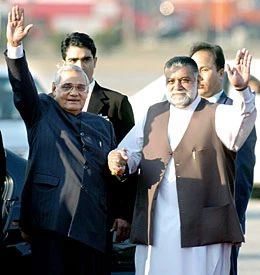
Vajpayee was welcomed at the heavily-guarded Islamabad International Airport by Jamali, Foreign Minister Khurshid Mahmud Kasuri, Finance Minister Shaukat Aziz, top brass and senior officials when he flew in on a private flight just before 3:30 p.m. (1030 GMT).
He was saluted by a military guard of honor, after which an armed forces band played India’s and Pakistan’s national anthems. Vajpayee and Jamali held hands and waved jointly to cameras as they left the tarmac in their first ever meeting.
The visit is the second by Vajpayee to Pakistan as India’s prime minister since 1999, when he traveled to the eastern city of Lahore by bus on a previous peace bid.
The 12th SAARC summit is also seen as an opportunity to revive the 18-year-old forum thanks to thawing India-Pakistan ties, to which it has been hostage most of its life.
India’s Foreign Minister Yashwant Sinha predicted the 12th SAARC summit would be “exceptionally successful and historic”.
“The atmosphere is cooperative, it is moving away from confrontation which is a good omen,” political analyst Talat Masood told AFP.
Business leaders hope it will raise inter-SAARC trade from four or five percent of their total trade output to 60 percent.
Nepal’s Prime Minister Surya Bahadur Thapa, Bhutan’s Prime Minister Lyonpo Jigme Yaeser Thinley and Maldives’ President Maumoon Abdul Gayoom also arrived yesterday.
Sri Lankan President Chandrika Kumaratunga is due to arrive early today.
Foreign Ministers Finalize Details of Free-Trade Area Accord
Meanwhile, South Asian foreign ministers yesterday finalized details of an accord on a regional free-trade area that is seen as a means of improving economic and political ties between Pakistan and India.
The agreement will be put before leaders of SAARC and would come into force at the start of 2006.
Pakistani Foreign Minister Khurshid Mahmud Kasuri said that under the agreement, the developing members of SAARC — Pakistan, India and Sri Lanka — would cut tariffs to between zero and five percent within seven years of the start of the agreement.
The region’s least developed states — Bangladesh, Nepal, Bhutan and the Maldives — would reduce tariffs to between zero and five percent within 10 years of the start of the agreement.
But, each member state will be allowed to maintain a list of sensitive products on which tariffs will not be reduced. The list will be finalized between now and the date on which the South Asian Free Trade Area (SAFTA) agreement is expected to come into force, Kasuri said.
Analysts said SAFTA’s success would depend mainly on whether India and Pakistan, the region’s two biggest economies, could overcome decades of animosity that have brought them to war three times.
Business leaders say Pakistan and India’s $1.5 billion trade through unofficial channels and third countries could double with a trade deal and better relations.
Settlement of Disputes Key to Regional Cooperation: Jamali
Pakistani Prime Minister Mir Zafarullah Khan Jamali says the only way to level the ground for regional cooperation was to settle bilateral disputes.
“Let us work for settlement of disputes ... this will help to generate greater regional cooperation,” Jamali said in an interview published yesterday.
The summit was originally scheduled for January 2003 but Indian refusal to attend resulted in its postponement.
In a reference to the lingering Kashmir problem, Jamali said “trade and economic ties cannot be sustained in a political vacuum and an environment of conflict and confrontation”.
“We see the summit in Islamabad as an opportunity for Pakistan to further deepen its engagement with SAARC,” he added.
Jamali also expressed the hope that the Summit will pave the way for resumption of dialogue between India and Pakistan for resolving all outstanding issues including the dispute over Kashmir.
South Asia Leaders Fly Into Huge Security Net
A massive security net was thrust around Islamabad airport as South Asian leaders began arriving yesterday for the summit in the wake of two attempts to kill President Pervez Musharraf. The airport was closed for two days to all commercial flights and the 13 kilometer (eight mile) road to the city was flanked by gun-toting troops, police commandos and plainclothes officers.
With sirens blaring, the leaders of the neighboring Himalayan kingdoms were whisked off in waiting limousines escorted by a convoy of army jeeps fitted with machineguns. Surveillance helicopters flew overhead.
Armed soldiers holding sniffer dogs prowled through airport lounges as journalists were subjected to special checks by security officials who scanned their equipment with metal detectors.
— Additional input from agencies