JEDDAH, 4 January 2004 — Raw sewage once more flows through the Al-Ajwad residential area, northeast of the Makkah Expressway and a few kilometers from the 15 million cubic meter sewage lake that receives daily deposits from 8,000 sewage trucks.
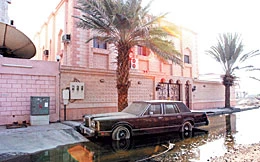
An area of expensive villas, Al-Ajwad suffers from the effect of rising groundwater combined with lack of sewage disposal. Villas in the area are surrounded by moats of filth that hum with flies and are a breeding ground for mosquitoes. The threat of insect-borne gastric diseases and malaria is extremely high. Local residents have complained for months to the municipality — but to no effect.
Jalal Ahmad, a local resident, said that the municipality was not addressing the root cause of the problem. Although the municipality drains the sewage and water from the street, it resurfaces.
“How can we live like this? Look around you. It is underground water mixed with excreta and there are flies and insects everywhere. Imagine, we cannot even walk in front of our houses. I have to park my car somewhere dry and walk the distance to my house because if I parked in front of my house, I would not be able to step out of the car without swimming in filth,” he said.
The problem is unfortunately not confined simply to water rising to the surface. Some of it is percolating into underground storage tanks. “Now we cannot drink, take a shower or wash our clothes,” said Ali Hassan, another resident. “I wish that the mayor of Jeddah would come and live in this neighborhood to see how bad it is.”
The problem is — again unfortunately — not about to go away. Jeddah stands on semi-permeable rocks — sandstone and coral — which act like a giant sponge. Under this there is a non-permeable layer of anhydrite. When the “sponge” layer is saturated, water rises to the surface and will continue to do so until the semi-permeable layer is drained. That layer is constantly fed by water tickling into the porous layer from the sewage lakes at Briman and the effect is made worse by the lack of suitable water run-off systems — such as mains drainage. Water deposited on the surface simply soaks in and resurfaces when the “sponge” layer is full. It then increases the already-existing problem.
Wells sunk into the semi-permeable layer extract water that then allow more to flow in from the wastewater on the surface, the sewage lakes in the east and the sea on the west. When the well water is returned to the surface, it simply adds to the cycle. The recent heavy rains have increased the wastewater load that the semi-permeable layer has to bear and the accompanying pictures illustrate the situation.