ISLAMABAD, 6 January 2004 — Leaders of South Asia’s arch foes, India and Pakistan, held landmark talks here yesterday, but their aides were guarded in their comments on the outcome.
Officials kept a tight lid on discussions between Indian Prime Minister Atal Behari Vajpayee and Gen. Pervez Musharraf of Pakistan, suggesting that revealing details could jeopardize nascent peace overtures between the nuclear-armed neighbors that both sides increasingly see as necessary to boost their relations and propel economic growth.
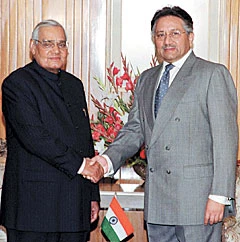
Musharraf welcomed Vajpayee at his Islamabad residence for a one-hour meeting.
“The two leaders discussed the positive impact of the recent confidence-building measures and hope that their momentum will be maintained,” said Masood Khan, a spokesman at Pakistan’s Foreign Ministry. “I want to make clear that I have not revealed the content of their discussions, only the context in which they were held.”
The men shook hands and were joined by their foreign and national security aides. Brief images were beamed over state-run Pakistani television, a sign of the meeting’s importance to further a thaw just two years after their armies stood on the brink of war.
But almost no specific details of their talks had filtered out many hours later, though Pakistan Information Minister Sheikh Rashid Ahmed said officials were working out “tangles” and would issue a declaration. He did not say when.
Sheikh Rashid said the meeting was cordial “and ended on a positive note. All issues were discussed openly. Their discussion was firm and comprehensive.”
But Indian Foreign Minister Yashwant Sinha appeared annoyed that even that much detail had been divulged.
“Both leaders welcomed recent steps toward normalization of relations between the two countries and expressed hope that the process will continue,” Sinha said. “Anyone who at this stage says any more will not be doing any service to either side.”
He repeatedly asked the media to avoid building hype that could raise expectations in both countries. His cautious approach stemmed from the collapse of a summit between the two leaders in the Taj Mahal city of Agra in 2001.
The biggest stumbling block in talks between the two countries is Kashmir. Reluctance by officials to discuss the Vajpayee-Musharraf meeting appeared to reflect the desire not to misspeak on an issue that has inflamed emotions for a half-century. Kashmir is divided between India and Pakistan, but each claims the territory in its entirety.
Sheikh Rashid was positive that “they discussed Kashmir.” Another Pakistani official said the two men tried to establish common ground to start a dialogue on Kashmir, which has caused two of their three wars and nearly triggered a nuclear confrontation in 2002.
Pakistan is hoping the talks will lead to dialogue on Kashmir, Foreign Ministry spokesman Khan told reporters. “That remains Pakistan’s hope,” he said.
“Right now, the priority is resumption of dialogue between the two countries.”
Vajpayee and Musharraf hoped “momentum would be maintained” after several months of normalization measures, Khan said, describing the atmosphere as “cordial.”
The meeting has generated a wave of optimism, with analysts heralding “winds of change” in the region. “There is a new atmosphere,” said former Pakistani Foreign Minister Agha Shahi. “These signs point to an apparent agreement by India to commence the dialogue, but when is not yet clear.”