
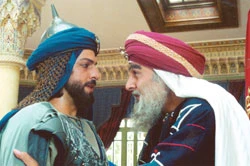
Although a relative newcomer to the field of acting, Tayem Hassan managed to land a major role in a huge project, "Rabie Kurtoba", ("Springtime in Cordoba"), one of the biggest Syrian TV dramas this season. He made his mark in historical roles in a number of successful series, like "Al-Zeer Salem", "Saqer Quraiesh" and "Al-Mutanabi", all dealing with historic Arabic figures.
Q: People noticed that you gravitate toward historical parts. Aren't you afraid that will hamper you when you move into present-day parts? Will your audience not be confused?
Tayem Hassan: It depends on the role you're playing. When I played the part of Al-Athed in "Salahuldeen", I was offered another part in a series set in the present. I couldn't take that part because I was busy with this important historical piece. The same thing happened when I was working on "Al-Waleed ibn Yazeed". Once you're committed to a historical part you've got to give it your all, and you have to turn down other things.
The offers I had for present-day parts just didn't measure up to the historical work I was doing. I think much more work needs to be done on these modern parts.
But no, since you ask, I'm not afraid that my audience only wants to see me in historical parts. We have to stop treating the audience as if they are simple-minded. I am an actor and I love to act.
Q: You achieved great success quickly, although you've only been in seven projects altogether. How come?
A: I cannot take more than one role at the same time. I believe in doing less work but doing it well. Too many TV parts will not achieve anything.
Q: What do you think of Syrian TV drama and of your accomplishment this season?
A: I believe we would be in a better position if we coordinated our efforts more: writers, producers and actors should really pull together instead of everybody doing their own thing. That would make us much stronger
Q: It's said that Syrian drama is produced at the whim of the Gulf countries. Is that true?
A: There are big Syrian companies with good reputations. They do produce good work, and that is how Syrian drama gets its reputation. So of course other countries are attracted by that.