
Leave the great thoroughfares of Jeddah for a short distance and the slick modern image of the city decays into something little better than a building site or garbage tip.
Outside immaculate courtyards swept and washed behind high walls, the rubbish thrown out from those same dwellings lies in accusatory contrast. “Leave it for the Hindi,” a local student replied when asked why he didn’t dispose of his rubbish in a bin. “It’s what they are here for.”
That kind of cynicism learned helplessness is now under attack from the Jeddah municipality in the form of a newly launched clean up initiative.
Dr. Walead Abdulaal, deputy mayor for services at the municipality, outlined the new four-year campaign. The first year will concentrate on litter, particularly things which are thrown out of cars, on the ground and building rubbish dumped on the streets.
Three key players are involved: the municipality, the contractor and the residents of Jeddah and all three need to integrate and cooperate. “The public has always been with us on the idea, but now the hope is to get them more involved, to develop cooperation and get to a more acceptable level of cleanness in the city,” he said.
The campaign’s main focus is to have more public involvement, particularly through education which will start with special programs for children in schools right through to university level.
Dr. Walead is not expecting change to be achieved overnight. He highlighted two things the public could do now: Not to throw anything out of the door or window; to put garbage in a bag first and then put it in the container. “If we get that far, it will be a major achievement,” he said.
He admitted there was a shortage of inspectors to police the current sloppy attitude toward littering the streets. He wants people to take ownership of the city and treat it with the same respect as their own homes and work with the municipality to tackle the problem.
One such collaborative measure is a free phone number — 940 — that has been made available for members of the public to report the location or number plates of offenders. The idea is to empower the public to enforce existing and new penalties for litter offenses, and to involve the public in the inspection program and its enforcement. “They will enforce it themselves. Everybody should take that responsibility,” Dr. Walead said. The campaign guidelines and exhortations are backed up with fines. They will not be implemented immediately, but are available as a sanction.
“We don’t want to penalize from the beginning,” said Dr. Walead, preferring education to sanctions. “Fines are for those not cooperating.” Offenders will be reported to the traffic police on a monthly basis who will then enforce collection.
The municipality has launched similar campaigns over the years. Emphasis and focus may vary — but this time it coincides with the beginning of a new cleaning contract, is incorporated into the budget for the cleaning of the city and the beginning of the new school year.
The new cleaning contract is for four years, but that will not be the end of the campaign. “There is no reason to stop after four years — we will keep the momentum going.”
Dr. Walead has a long perspective for the campaign. He cites the example of the UK where the “Keep Britain Tidy” campaign lasted for two generations. He expects few instant results, save a reduction of obviously bad habits. “We have to start the journey somewhere,” he said philosophically. “And this is the first step.”
Most of the employees of the cleaning contractors out on the street are not Saudis. Will there ever be a move to involve Saudis in the cleaning at street level? Dr. Walead is hopeful.
“Why not? Involve them and show it as a valuable community job.” Again he pointed to the European example where “dustmen” became “environmental operatives” and after the jeering at the euphemism had subsided, the public attitude changed to seeing their function as socially and environmentally valuable. Already there are 100 Saudi supervisors who are out on the streets where most of their work is field work. “As yet it is a bit early to introduce Saudis at the street level of doing the actual cleaning.”
Companies, as well as individuals, are invited to get involved. “It will be good — for food and packaging companies for example — to cooperate with the municipality because the feedback will be good for them,” said Dr. Walead. “Every company is welcome.”
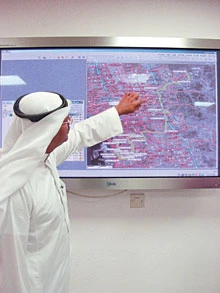
As evidence of how deeply committed the municipality is to keeping the city clean on a long-term basis, he demonstrated their latest investment: Automatic Vehicle Location (AVL). Run from a simple — even sparse — control room, this powerful piece of technology monitors the movement of every one of the 600 compacter trucks on each of their 1,800 routes and the 26,000 orange garbage bins in the city. Every movement is logged. A huge wall mounted display panel shows a satellite map of Jeddah and the location of every truck and bin second by second to an accuracy of 30 cm.
“It is proving to be a very powerful management tool,” said Dr. Walead. “We know where the problems are, the contractors can be informed and both they and the municipality can tighten control and achieve much greater efficiency.”
The essence of the campaign is cooperation — a word used very frequently by Dr. Walead. “It’s about culture change, a change in the minds of the citizens,” he said. “It is not going to happen in five minutes or five years, but it will happen if we keep the pressure up. Jeddah deserves it.”