
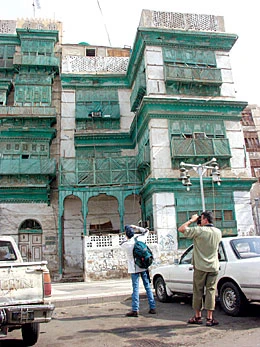
Being a big country, and one undergoing great changes, Saudi Arabia is often called a land of contrasts. Centuries-old traditions coexist with a high-tech, consumer society. But during a recent one-month stay in Jeddah, the most glaring contrast I found was the gap between the local atmosphere and the outside world’s perceptions of it.
Before I left Denmark in mid-November, friends and colleagues really meant it when they told me to take care, and some were clearly very worried that I was going to such a dangerous place. This was just after the second terrorist attack on a compound in Riyadh. The warnings were repeated when I stopped over in Cairo on my way to Jeddah.
But after a couple of days during which you try to be on the lookout for anything unusual, you give up, realizing how very ordinary everything is. Compared with my earlier visits to Jeddah, there does not even seem to be significantly more police around. Apart from an armed guard and concrete barriers in front of a few ministerial buildings, security seems normal.
True, the US Consulate looks rather like a fortress, but so does the US Embassy in my own country, Denmark. Even more important, I found the atmosphere in Jeddah to be relaxed, with none of the tension you feel in countries under threat of violence.
I got a friendly reception by all the people I encountered, whether Saudis or not. Many went out of their way to help me (from the Saudi owner of Nokia shop — who solved a problem I had with operating my recently acquired mobile — to the Egyptian pharmacist who supplied me with a city map when I asked him for directions.)
I was told that Jeddah is still, as it traditionally has been, more open in its attitude to strangers than other parts of the country. However, I never encountered the kind of people whose idea of piety seems to limit their sense of humanity to their own community.
I once entered the courtyard of a madrassa in the belief it was a hotel, a mistake helped along by a hotel sign on the wall. The caretaker, sporting an impressive beard, took the intrusion with a smile and went with me to help find the hotel, hidden by scaffolding, several hundred yards away. At the end of our conversation, he suddenly switched into English, presumably as an additional token of kindness.
Of course, when judging these happy impressions, one may have to allow for the fact that I did not stay in one of the compounds for Westerners that have been targeted by the terrorists. Instead, I made my temporary home in an apartment hotel near the Casablanca Hotel in Salamah district. The guests were Arabs, and the staff Saudi and Bangladeshi. Indeed, the only time I noticed a Westerner in Salamah district was a week before my departure. The fact that many Westerners have sent their dependents home after the attacks is no doubt a factor here, though I have no idea how big.
In this atmosphere, the news from Riyadh about the terrorists seemed very remote. (The gunfight in which one terrorist was killed, the news that his accomplices had spied on an American compound, the pictures of wanted men with the photo of the dead man crossed out, all this was almost like news from a different continent.)
So it is with expectations severely shaken that I have returned from my month in Jeddah. It may be that Riyadh is different. It is true that the Saudis I met expected the terrorism problem to last for quite a while, even years, not because the terrorists are numerous, but because they are fanatical and well-organized. But the normalcy I experienced in Jeddah, and the way its people take the situation in their stride, seems to me to hold an important lesson. Although a violent minority can always cause pain, it is much harder to shake an entire country.
* * *
(Lars Moller-Rasmussen is a journalist with Danmarks Radio.)