NAGOYA, 21 January 2004 — Five members of the Ministry of Education’s Department of Curriculum Development are currently in Japan. During their one-month stay, they will study Japanese methods of education in order to aid in the development of the Kingdom’s new curriculum.
The team, led by Dr. Abdulillah Abdullah Al-Mosharraf, director general of curriculum development, consists of Shakir Nasir Al-Shareef, Muhammad Abdullah Al-Zaghibi, Abdullah Muhammad Al-Otaibi and Abdul Rahman Hamad Al-Huzaimy, all of whom are members of the Department of Curriculum Development.
The Saudi delegation is sponsored by the Japanese International Cooperation Agency (JICA), a Japanese governmental organization. JICA is working with the Ministry of Education in order to develop a new curriculum for Saudi Arabia based on Japanese models. The training course offers an overview of the Japanese educational system.
Members of the delegation will study methods of curriculum development, observe Japanese industrial technology from an educational standpoint and review the relevancy of school education in an industrial society.
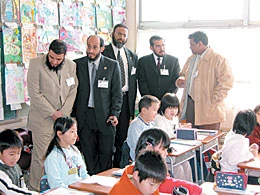
Members of the delegation, accompanied by Arab News, visited Chiryu Elementary School, the largest of 10 public schools in the city of Chiryu. The school principal welcomed the members of the delegation.
“All our students study Japanese, math, science, social studies, music, arts, home making, physical and moral education and extracurricular activities. All school subjects and their contents are set by the Ministry of Education and Science. For this reason, any child can have the same education anywhere in Japan. Even if a child moves to other parts of the country, his or her educational standard will be the same,” the school principal told the delegates.
The principal admitted that there were problems but that the search for solutions was never-ending. He also praised cooperation between parents, students and staff.
After touring the school, seeing various classrooms and talking to both students and teachers, Al-Mosharraf expressed his admiration for Japanese methods. “There is a fruitful learning environment here. The students and staff are provided with all the necessary equipment and tools to help them learn. We will take much of what we learned here home with us to Saudi Arabia. We have seen some different approaches to teaching,” he said.
In Japan, public school education is free. Parents on average spend only about $100 per student per year for teaching materials that are not provided by the school. In addition, the school pays half the cost of the school lunches. Japanese students are not held back a semester or a year if they fail their exams. Instead, they are required to attend extra hours and summer sessions to help them attain passing levels and remain with their class.