MINA, 3 February 2004 — Grief and trauma will remain with some of the survivors of the Jamrat stampede for the rest of their lives. They are the ones who escaped the rush and crush that claimed 251 lives. For some, bodily healing will be swift, but for others the ache would be lifelong after seeing their family, relatives or friends die.
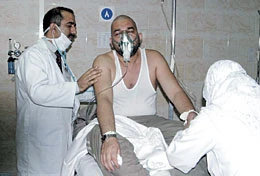
Arab News yesterday visited Mina Bridge Hospital, one of the four hospitals where 80 of those injured in Sunday’s stampede are recovering. According to hospital sources, many of them are in serious but stable condition. Some, who are recovering from slight wounds, are likely to be discharged soon. The 80 injured include people from India, Pakistan, Egypt, Bangladesh and Morocco.
A sad tale is that of India’s Rafiq Shafiq, 54, whose wife died in the tragedy. He holds himself responsible for her death, saying it was his obstinacy in going early to stone the Jamrat that led to their being caught in the rush. Shafiq, who repeatedly broke down while telling what happened, said his wife did not want to go early to complete the ritual.
“When I told her that we would stone the Satan early in the morning, she asked me to delay a bit as there would be a big rush at the site. I did not listen to her and forced her to accompany me. Though the crowd was huge, we made our way toward the Jamrat. In the excitement of stoning the devil, I forgot everything, even my wife. After I had successfully completed the stoning, I turned to look for my wife beside me. She was not there. It was at that moment that trouble started. I don’t recall everything as it all happened in a flash and the events are a blur. When calm was restored, I began searching for my wife. After some time I saw her body among the row of dead bodies on stretchers,” he said.
“She was so serene. It was like she was sleeping peacefully,” said Shafiq, whose sobbing had become uncontrollable. He added that the only solace he finds is that his wife will surely find a place in paradise.
Moroccan Ahmad Hakim too was caught in the stampede and suffered major injuries, including a fractured hand. It is the trauma of losing his friend in the tragedy and being caught in one that is affecting Hakim more. “They will cure my fractured hand and the other bruises I suffered but who’ll cure the ache in my heart?” said Hakim.
Hakim said he met his friend, also a Moroccan, during the Haj. “We became close,” Hakim said of his friend who died in the tragedy. “On Sunday our group left camp for the ritual. My friend was walking beside me. The moment we reached the Jamrat area, the stampede occurred and in the rush and crush of bodies we were separated. Everyone, including me, was trying to save themselves,” he said. Once normalcy had been restored, Hakim began the search for his friend and saw him on a stretcher among the dead. “Just in a moment, he was separated from me forever,” he said.
Muhammad Khan, 44, of Pakistan was nearing Jamrat when the stampede began. “I saw a pilgrim falling. Reflexively I ran to help him and in the very next moment, I too was caught in the crush. My body was bruised everywhere and I am in pain.”
Ahmad Murad, 43, of Cairo, Egypt, too suffered bruises all over his body and has a swollen eye. He thanked the Almighty for sparing his life.
He admitted that it was a poor decision to rush to complete the ritual.