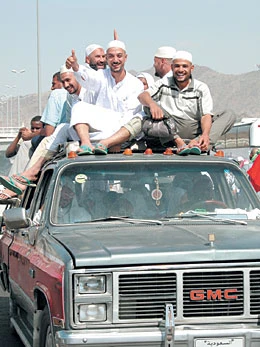
MINA, 4 February 2004 — Forty-two-year-old Aminu Dayyabu is a teacher in Nigeria’s Katsina state. Basking in the bright morning sun in the tent city on the last day of Haj, he was relaxed and exuded an air of spirituality.
“Ever since I came back from the plain of Arafat, I have been in a state of excitement. So many people wearing the same clothes, reciting the same talbiyah, doing the same thing, imploring the same God, crying their hearts out. Unbelievable!” Aminu said.
“This is my first Haj and I had no idea how powerful these symbols of Islam were. We saw on television what happens during Haj but television does not give you any idea about what actually happens on the ground. The reality is totally different. It is when we come here that we realize how fragile and insignificant we are. Just one speck on the vast earth,” he said.
Aminu counts himself lucky in that “not many people in my country can afford to undertake this journey but when it comes to faith, we are the equal of any other Muslim. I will be treated like a celebrity when I go back to my village. I will have a new status. Every step that I take from now will be looked at. There will be great pressure on me not to go astray. And then those in my village will come to me with all their problems. Everybody will go by what I say. That is how it is in my country. Haj puts a big responsibility on us.”
Aminu is saddened by the divisions that wrack the Muslim Ummah, the community of believers. “I can’t understand why we don’t unite to take on our enemies. Remember the fable of a father with four sons. United we stand divided we fall, and we are suffering. Our contribution to the 21st century is minimal or, let me say, non-existent. What have we given the world? We have not even projected the correct image of Islam. We are a quarrelsome community and once every year we come together in Haj to renew our faith. But there is more to Haj. The message of Haj is unity. Not only on the plain of Arafat but beyond it as well.”