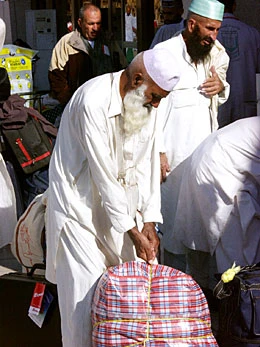
JEDDAH, 5 February 2004 — The trickle of pilgrims now gathering at King Abdul Aziz International Airport will soon become a flood. The concourse and paved areas outside the International Departures building is a Muslim melting pot and temporary caravanserai to thousands of Haj pilgrims making their way back home.
Organization of the several thousand travelers has been casual but effective so far; this may well change as numbers swell enormously over the next few days. Security is evident, though far from oppressive and occasional red berets are highly visible in the mass of white garments.
Already however, the strain is showing on both the system and the travelers. The airport’s departure and arrival announcement boards appeared not to be functioning yesterday. This has created considerable confusion as many passengers speak neither Arabic or English — and even if they did, the information displayed is often inaccurate.
One Garuda Indonesian airline crew was proceeding to their aircraft yet, according to the board, the aircraft was not due to leave for another six hours. An airport official waved dismissively with a wry grin at the announcement boards. “Do not pay any attention to those; they never work,” he said.
This was no help to pilgrims from Turkey, India, Algeria, Pakistan, North America, Indonesia and others, who were milling about on the concourse, frantically asking anyone in a uniform for information.
Porters, keen to make a quick riyal, scuttled with teetering towers of luggage balanced precariously on trolleys and often confronted each other head-on in the narrow aisles. Right of way is conceded after a brief exchange.
In a group of Algerian pilgrims, a loud altercation broke out and quickly developed into a shoving match. The dispute, quickly and courteously broken up by airport security, concerned the return of one traveler’s tickets held by another as security for a SR500 loan.
Many of the pilgrims were hours ahead of their scheduled flights. Dotted in the shade and surrounded by fortress-like walls of luggage, families sat on the floor patiently waiting for their flight call.
They ate pre-prepared meals of curries, rice, pickles and bread. Some simply slept; mats had been unrolled and pilgrims who were clearly exhausted flopped motionless onto the warm marble floor, trusting others to wake them in time for their flights.
Shops on the concourse were doing only moderate business but were well stocked with Zamzam water and many varieties of dates. “They are mostly what pilgrims are buying,” the shop attendant told Arab News despite the fact that most pilgrims had already bought huge containers of Zamzam water in Makkah.
Zamzam water is giving airline officials headaches. Ten liters of water is half the baggage allowance on many airlines. Most pilgrims have several items to check in and strongly worded conversations take place at many of the airline desks.
One airport official told Arab News that delays were inevitable because of excess baggage problem.
“The experience of Haj is often a once in a lifetime occasion for the pilgrims,” the official said. “We do what we can, but there are always some who push the limits,” he said with a shrug. “It slows down processing tremendously.”
Most of the travelers at the airport had bypassed Jeddah and so had had no opportunity to see or shop in the city.
“My family and I spent two weeks in Madinah before the start of the Haj,” said Mohammed Darr, 65 a Pakistani pilgrim. “We have completed Haj, we are comfortable and fulfilled and we now want to go home in peace.”
Other groups of pilgrims were leaving as planned, directly after their Haj because they were concerned about the stamina of their elderly fellow Hajis.