JEDDAH, 9 February 2004 — Eid is an important occasion in the Islamic world. Not only does it strengthen social and family ties but it also reinforces these values in a happy and joyful environment. It is a time for people to be thoughtful with the faithful strengthening their faith and thinking closely about the values that Islam stands for. Islam, which involves charity in every action of our day-to-day lives, is a religion of giving. Though Muslims offer help throughout the year, it is on the occasions of Eid that the spirit translates into total action throughout the Muslim world. The rich and those who are able to give in the community come out in droves to offer help to the less fortunate. Thus charitable activities are a major part of Eid.
Here in the Kingdom, Eid plays a big role in furthering relationships between leaders and people. It is during this period that the senior members of the Saudi leadership take time out of their schedules to meet top military and civilian officials as well as ordinary citizens.
Prince Sultan, second deputy premier and minister of defense and aviation, has set an example by visiting armed forces personnel in various parts of the Kingdom during both Eids — the Eid Al-Fitr, marking the end of the fasting month of Ramadan, and the Eid Al-Adha or the Feast of the Sacrifice, commemorating the Prophet Abraham’s (peace be upon him) readiness to sacrifice his son according to God’s instructions.
The prince takes part in the Eid celebrations organized by the armed forces stationed in remote areas of the country, sharing their happiness while also listening to their hopes and aspirations. He takes quick steps to meet their requirements in areas as diverse as housing, health services, recreation and their children’s education.
People look forward to Prince Sultan’s tours during the Eid holidays as such visits often herald the opening of much needed development and humanitarian projects.
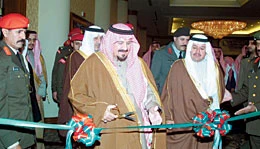
This year the prince selected areas in the south of the Kingdom for his annual visit during the Eid Al-Adha holiday: Najran, Asir and Jizan. The royal visit, which began last Tuesday, saw the launch of several projects including the King Fahd Mosque in Najran which can accommodate nearly 6,000 worshipers, including women.
Prince Sultan’s itinerary during his visit to the southern region included not only meetings with top military commanders but also inaugurating several projects. In Najran he opened the new headquarters of the Ministry of Islamic Affairs and addressed a public meeting at which he emphasized the special position the people of Najran have in the hearts of the Saudi leadership. He also opened a charitable housing project. The Prince Sultan Charitable Foundation, a non-profitable charitable organization set up by the defense minister in 1995, donated SR22 million for the housing project. On an area of 105,400 sq mt, the project includes 120 housing units, schools, a mosque, commercial and recreational centers, gardens and public utilities. Within eight years, The Prince Sultan Foundation has established itself as one of the foremost charitable organizations because of its wide range of humanitarian and charitable activities. The charity’s principal objectives are the provision of humanitarian, social and cultural services in Saudi Arabia and abroad.
Its objectives are achieved by means of a number of projects including the 400-bed Sultan ibn Abdul Aziz Complex for Humanitarian Services north of Riyadh. The Sultan ibn Abdul Aziz Center for Science and Technology is another major project in the Eastern Province city of Alkhobar. The Sultan ibn Abdul Aziz Special Education Program at the University of the Gulf in Bahrain and the Sultan ibn Abdul Aziz Program for Arab and Islamic Studies at the University of California, Berkeley, are other examples of the charity’s projects in various disciplines.
In the second phase of his trip, Prince Sultan opened a major seminar, organized by King Khaled University in Abha, dealing with e-commerce in the region. In his opening address, Prince Sultan emphasized the government’s efforts to avoid cultural isolation and achieve modern development without discarding its principles and values. “We support every effort that serves the Kingdom’s interests and conforms with our Shariah,” the prince said.
The prince will also visit Jizan, where he is scheduled to launch a series of cultural and humanitarian projects — the Prince Sultan Kidney Center at the King Fahd Hospital, the Prince Sultan Cultural Center and the Prince Muhammad ibn Nasser Charitable Housing Society.
“We are accustomed to these gracious and generous visits by Prince Sultan which are part of his nationwide tour to participate in the armed forces’ Eid celebrations. These royal visits are undoubtedly blessed times and bring glad tidings to people in all parts of the country,” said Prince Muhammad ibn Nasser, the governor of Jizan.