
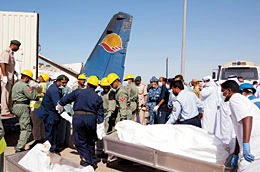
SHARJAH, United Arab Emirates, 11 February 2004 — An Iranian Fokker 50 plane carrying mainly Asians and Iranians crashed as it prepared to land at Sharjah airport and burst into flames, killing 43 people aboard but causing no casualties on the ground. Three survivors were being treated at a hospital. The dead included six Iranian crew members.
Authorities recovered the voice cockpit and flight data recorders from the smoldering debris, which are likely to provide clues to the cause of the crash. A crane picked through the charred wreckage, lifting chunks of the broken aircraft. Only the tail and cockpit area were recognizable.
About 30 charred bodies were laid out in rows and covered with red blankets near the wreckage. The bodies were intact, but burned beyond recognition; one was of a baby girl. The Kish Air Fokker 50 crashed at 11:40 a.m. (0740 GMT) in an open area about 3 kilometers (2 miles) from the airport, said Ghanem Al-Hajiry, director general of civil aviation and the Sharjah Airport Authority. The plane struck the road about 200 meters (660 feet) from the nearest homes in the upscale neighborhood.
The victims were arriving from Kish Island. The island is a popular nearby destination for Asian workers in the Emirates who need to leave the country to renew their visas. Al-Hajiry said the cause of the crash was not yet known. The Fokker 50 that crashed was 11 years old, according to the Dutch company Stork, which owns much of Fokker’s assets — far newer than most passenger planes in Iran’s aging fleet. The plane was delivered to Kish Air in 2002.
Stork spokesman Koos Huurdeman said major maintenance on the plane was carried out by Fokker Services, which is a division under Stork, and that Kish Air handled minor maintenance. He said it would be up to Kish Air to discuss the plane’s maintenance history. In Tehran, Kish Airline officials refused to comment, even to confirm the crash.
Mohammed Al-Ghaith, another senior civil aviation official, said that the pilots had not sent out an emergency call. He said the black boxes, which record flight data and cockpit voice information, had been found and that an Iranian delegation was en route to take part in the investigation.
Col. Saleh Ali Al-Mutawaa, general director of Sharjah Police, said 43 of the 46 people aboard the plane had died: 12 Indians, 19 Iranians, four Egyptians, two Filipinos, two Algerians, one Syrian, one Chinese, one Nigerian and a Bangladeshi.
Three crash victims were receiving treatment at Al-Qasimi hospital in Sharjah, an emergency room attendant at the hospital confirmed to The Associated Press. Two of them were in critical condition, he said. The attendant did not provide a condition on the third, who was reported as stable.
-— Additional input from agencies

