
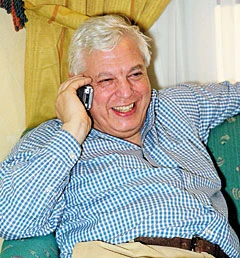
Why mess up a good story with facts? That rhetorical but accusing question is often used to sum up a suspicion that reports in the press are sometimes not only less than accurate but also less than honest.
John Simpson is suspicious of reporters publishing facts about him. “There are always facts — but facts never seem to be entirely accurate. The facts about where I was born, where I went to university, this sort of thing and it rather irritates me, I must say.”
So this article is personal, it is opinion and it is impressionistic, a recounting of an encounter with a consummate professional, who is very human.
Some of the facts are straightforward enough. John Simpson is the BBC’s World Affairs Editor, and for many years has been a familiar voice and face on BBC radio and TV, in Britain and on the BBC World Service. Another fact, but not so well known, is that he and a BBC team were recently in Jeddah for over a week to cover the Haj.
But it is as easy to describe John Simpson as what he is not as what he is. Unlike many internationally famous figures, he is not smaller than he appears on television. “Six foot two and rather bulky,” he says of himself. Even with the build of a rugby lock-forward, somehow he doesn’t loom over company or fill the room.
Neither is he loud nor instantly charismatic but has a rather self-effacing tendency to swap between “I” and “You” when talking about himself.
He neither dominates a conversation nor frequently prefix his replies — even to direct questions — with “I.” But then he’s not trying to convince anyone of his opinion; it was quite difficult to get one out of him. Facts are his life. His gentle and beautifully modulated tones, redolent of reason and analysis, are though reassuringly familiar.
With a tendency to look into the middle distance while thinking through answers to tangential questions, he twisted a sliver of stationery almost into its component molecules while we talked. Nervousness — from the man who has been in and survived 30 wars — or simply uncomfortable about answering rather than asking questions?
Now at the apogee of a long career and invariably listening, absorbing his surroundings, does he separate what he does from what he is?
“I have certainly been shaped by it,” he says. He admits to having been made much more skeptical than he would otherwise have been and more worldly-wise. “Nevertheless, I do it because that is the instinct — to talk to people about what you have seen and done. The important thing then becomes to do things that are worth seeing and to tell stories that are worth telling.”
The challenges of his career have resulted in some very hazardous moments — not least being bombed in Iraq by a US plane. His translator and 18 other people were killed in front of him, many of them burned to death.
“Not a nice experience,” he muttered, clearly affected. “It was absolutely clear to me that this was something that you could go on and on about and constantly feel angry and bitter about — it’s something that has simply got to be dealt with.”
The job itself is partly a cathartic remedy to handle extreme experiences like this. “I find that writing and broadcasting about it has helped,” he said. “I don’t dream about it at night, no unresolved anger. I don’t feel bitterness or anger — it’s over, and finished and I am grateful to be alive.”
John Simpson’s trademark is his cool composure. How does he maintain his professional distance from situations where many nearby are breaking up emotionally? Can a cutting-edge reporter really be as ice-cool as he seems?
Unsurprisingly, no.
“I think as you get older you do actually tend to feel a greater emotional involvement than before, in many ways,” he said. The drive to communicate the reality of the situation is coupled with a clear, reasoning mind, sufficient to sustain him at least for the moment.
“The only use I can be under those circumstances is to tell people the reality of what’s going on. It’s done better if it’s done coolly and calmly, rather than excitably. But that doesn’t mean that I don’t feel worked up by these things — I often do and it’s often an effort to grab yourself and make yourself appear to be calm.”
Sometimes though during his long career, the raw emotions of the moment got through.
“Yeah... a bit in various places,” he said very quietly. “I try to cover it up, as best I can really. Tiananmen Square actually... I got very heavily involved there — I just couldn’t bear to see so many people being killed.”
“As a whopping great Westerner, 6 foot 2 — rather sort of bulky, you have a certain presence in a country like China, and I used it quite a lot, because I just didn’t want to see anybody else getting... getting killed, really. I’m not proud of those moments, because I think it shows a certain sort of weakness... I don’t think you should get too involved — you should keep your distance.”
He agreed with the rubric of a crusty sergeant instructor of new cadet officers, who surprised them by admitting “We’re all afraid, son, but it’s what you do when you are afraid that counts.”
“Absolutely right, but I wish I could say I have always done the right thing,” and added nearly inaudibly “but I don’t think I have.” Prompted, he continued, “Well there are times when I think I would have liked to have done something better, something more.”
So what ultimately keeps Simpson going about his sometimes incredibly dangerous job?
In short, “inquisitiveness; it is militant, rampant curiosity that keeps me going. That and getting it right. There is that whole thing in the BBC about getting things right, which makes you feel hugely, hugely guilty if you don’t do it right.”
Simpson admits that he is not paid to back off from an assignment and considers the BBC, to which he has committed his whole working life, to be simply the best broadcasting organization in the world. So what, apart from the “lust to know” keeps him at it, often at considerable personal risk?
“The most important guide — and this sounds so Victorian — it’s what you know you must do, and I think you have got to put that before the fear and the timidity and the anxieties and all of that.” In a word, duty; to the organization he holds in such esteem, to explaining to the world what he finds and, on senses, to the sense of the “rightness” of what he does.
The one person that for certain will not read this is John Simpson himself. He never reads anything written about himself because, he says, “I have never yet read an article about me that was 100 percent accurate, which of course makes you think about the nature of journalism in general, but that is certainly the truth. It seems to me that I have never seen an interview that is 100 percent correct. I prefer not to have to deal with it.”
So just how much of the “shambling man in the crumpled suit” is contrived, where is the genuine John Simpson?
“The problem, I think is that people have a view of you,” he said, “especially if they see you a lot. They assume that you are whatever they choose to make you. I don’t know what that might be.”