
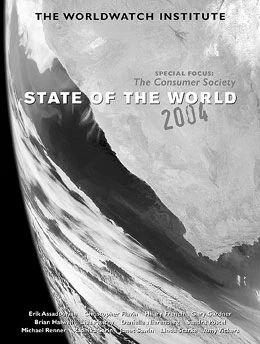
WASHINGTON, 15 February 2004 — The outlook for the world in 2004 is pretty awful.
The world is consuming goods and services at an unsustainable pace — with serious consequences for the well-being of people and the planet, notes the Washington-based Worldwatch Institute in its annual report, “The State of the World 2004.”
Much of the world’s population has enjoyed massive increases in calorie intake, housing quality, household appliances, and scores of other amenities of the past half-century have helped lift hundreds of millions of people out of poverty, says Worldwatch.
But consumption among the wealthy elite, and increasingly among the middle class, has in recent decades gone well beyond satiating needs or even fulfilling dreams to become an end in its own. The unbounded pursuit of consumption has also exacted a heavy cost. Consumption today absorbs vast quantities of resources, many of which are now being used far beyond sustainable levels.
In just 50 years, global use of fresh water has grown threefold, while fossil fuel use has risen fivefold. Renewable resources are particularly under threat. Worldwatch says the average American consumes five times more energy than the average global citizen and nearly 20 times more than the average Indian. The US, with just 4.5 percent of the global population, uses about a quarter of the world’s fossil fuel resources.
The biggest drinking problem in the US, says Worldwatch, is not alcohol but lawn watering. The irrigation of US lawns and landscapes daily claims an estimated 30 billion liters of water.
Smoking contributes to around 5 million deaths worldwide each year. In 1999, tobacco-related illnesses cost the United States more than $150 billion — almost 1.5 times the revenue of the five largest multinational tobacco companies that year.
Over 65 percent of adults in the US are either overweight or obese, leading 300,000 deaths yearly and at least $117 billion in health care costs in 1999.
But the growing disparities between the developed and developing nations are disturbing: Some 2.8 billion people — two in every five humans on the planet — lived on less than $2 a day in 1999. One in five people in the developing world — 1.1 billion — did not have “reasonable access” to safe drinking water in 2000. Over 2.4 billion people in the world — two out of every five — live without basic sanitation.
The pattern of the past half-century is clear: The pollution and resource degradation that flow from ever-growing consumption continue to worsen, and the toll is being measured not just in damaged ecosystems but in disease and misery — particularly for the world’s poorest citizens.
“Rising consumption has helped meet basic needs and create jobs,” says Worldwatch Institute President Christopher Flavin. “But as we enter a new century, this unprecedented consumer appetite is undermining the natural systems we all depend on, and making it even harder for the world’s poor to meet their basic needs.”
“High levels of obesity and personal debt, chronic time shortages, and a degraded environment are all signs that excessive consumption is diminishing the quality of life for many people,” says Flavin. “The challenge now is to mobilize governments, businesses and citizens to shift their focus away from the unrestrained accumulation of goods and toward finding ways to ensure a better life for all.”
Worldwatch’s facts are staggering throughout the report.
Regarding farm factories, which many people feel treats animals cruelly and even brutally, Worldwatch says the globe’s appetite for meat has increased more than fivefold since 1950, and factory farming is the fastest growing method of animal production worldwide.
By 2020, people in developing countries will consume more than 39 kilograms of meat per person — twice as much as they did in the 1980s. People in industrial countries will consume the most meat — 100 kilograms a year. Yet the question is whether the system that delivers all this meat to them can persist as its deficiencies mount.
The cascading problems of animal factories begin with the cramped considerations and the feedlot diet. Cows are ruminants, meaning they digest grasses, but their feedlot food causes cows to suffer from bloating acidosis, liver abscesses, gas and other symptoms of a rich diet.
The standard diet in factory farms has also been linked to the spread of food-borne pathogens, which can contaminate meat or fever vegetables if the raw manure is used as fertilizer. A cow’s factory diet also encourages the growth of the harmful microbe in the cow’s stomach, whereas a grass diet eliminates the microbes. Which is one reason that cattle and other livestock are fed antibiotics.
In the US, livestock consume eight times more antibiotics by volume than humans. According to the World Health Organization and the Food and Agricultural Organization, the widespread use of these drugs in the livestock industry is helping breed antibiotic-resistance microbes, and making it harder to fight diseases among both animals and humans alike. But the crowded, unsanitary conditions weaken the animals further, and lethal diseases can spread rapidly in the unhealthy herd or flock.
How much longer farmers can continue to depend on heavy doses of agrochemicals is another important question. Pests have shown an uncanny ability to dodge, resist and evolve. Even genetically engineered crops, which were touted as helping to eliminate pesticide use, are vulnerable to the resistance treadmill. Researchers have discovered that common weeds that have developed resistance to many herbicides will necessitate further pesticide use. As a result, farmers have spent billions of dollars attacking increasingly resistant pests with increasingly potent chemicals, and most pesticides have ended up in our water, air, soil and bodies.
Although the public benefits of organic farming — reduced water pollution or increased wildlife — are fueling some growth in sales, the greatest interest has come from consumers with more personal concerns, says Worldwatch. Parents, for instance, may choose to feed their children organic food — knowing that small, developing bodies are more sensitive to endocrine-disrupting pesticides, residues or antibiotics as well as the hormones and other synthetic ingredients used routinely in food production.
The European Union banned the import of beef from the US after growth-promoting hormones were found in the meat, because they deemed the hormones are health risks. The US took the dispute to the World Trade Organization, arguing that the ban constituted an unfair trade barrier.
In 1998, the WTO panel ruled that the EU ban was inconsistent with the world body’s regulations, but the EU refused to lift the ban. In 1999, the US imposed $117 million per year in retaliatory trade restrictions against the EU. Following the release of new studies showing that growth hormones pose a risk to human health, in October 2003 the EU issued a new directive that refined its bans on various growth hormones found in meat.
Worldwatch notes that in the US, an estimated 65 percent of adults are overweight or obese, leading to an annual loss of 300,000 lives and at least $117 billion in health care costs in 1999.
Finally, the World Values Survey, an assessment of life satisfaction in more than 65 countries conducted between 1990 and 2000, found that income and happiness tend to track well until about $13,000 of annual income per person. After that, additional income appears to yield only modest additions in self-reported happiness.
Let us end on a happy note: Providing adequate food, clean water and basic education for the world’s poorest could easily be achieved for less than what people spend annually on makeup, ice cream and perfumes.