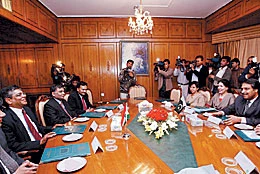
ISLAMABAD, 17 February 2004 — India and Pakistan yesterday began their historic first peace talks for two-and-a-half years amid what officials say is “new momentum” toward resolving decades of bitter conflict.
“There is realization in India and Pakistan that war is not an option, that you have to look at ways to find a peaceful resolution of the outstanding disputes between the two countries,” Pakistani Foreign Ministry spokesman Masood Khan said yesterday.
“There’s new momentum,” Khan said. “This momentum must be maintained.”
The meeting between delegates headed by joint secretary of the Indian External Affairs Ministry, Arun Kumar Singh, and director general for South Asia at the Pakistani Foreign Ministry, Jalil Abbas Jilani, lasted for nearly two hours, Khan said.
“Both sides discussed modalities and timeframe for resumption of the composite dialogue. In this context some proposals were exchanged,” Khan said.
“The process of composite dialogue has commenced today after an interruption of two-and-a-half years,” he said.
“All subjects will be discussed and concerns will be addressed when you sit across the table,” he said, declining to give details.
After two days of talks between officials, Indian Foreign Secretary Shashank and Pakistani counterpart Riaz Khokhar will join the discussions tomorrow.
The foreign secretaries will review the agenda to be finalized by the officials and announce the dates for the next round.
The United States and European Union both welcomed the talks.
“We’re pleased that India and Pakistan continue to work together to reduce tensions,” said White House spokeswoman Claire Buchan.
But the European Union also cautioned against expectations that the Kashmir dispute would be resolved soon.
“I think the outside world should be patient. I think they have started the process but the issues involved are very complicated and difficult and we should not expect early results,” European Commission External Relations Commissioner Christopher Patten said in New Delhi.
Pakistani President Pervez Musharraf and Indian Prime Minister Atal Behari Vajpayee agreed at a regional summit last month to start the composite dialogue process and expressed confidence it could achieve results.
The summit drew a line under several years of tense relations which included a major military battle in Kashmir in 1999 and a military build-up in 2002 which brought the two countries close to nuclear war.
— Additional input from agencies