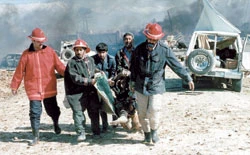
TEHRAN, 19 February 2004 — A massive explosion aboard runaway train carriages hauling fuel and industrial chemicals killed more than 300 people in northeastern Iran yesterday, including top local officials, firefighters and rescue workers who were extinguishing a blaze that began when the cars derailed.
The explosion outside Neyshabur, a historical city 650 kilometers (400 miles) east of the capital, Tehran, was so powerful that residents thought it was an earthquake. Iranian seismologists recorded a 3.6-magnitude tremor at the exact time of the blast, the official Islamic Republic News Agency reported.
Top Neyshabur city officials — including the local governor, mayor and fire chief — were among the dead, along with 295 fire and rescue workers. At least 400 people were reported injured, most of them were injured when their mud homes near the train tracks collapsed under the explosion’s force.
IRNA quoted Mehran Vakili, Neyshabur’s medical examiner, as saying that by yesterday evening 300 bodies had been recovered. It was not immediately clear what caused the 51 carriages to roll out of Abu Muslim station, outside Neyshabur, at 4 a.m. local time (0030 GMT). But IRNA reported that “some vibrations” had set the cars in motion.
The train cars picked up speed, moving without an engine or anyone in control, and 48 of them overturned on reaching Khayyam, the next stop on from Abu Muslim, starting a blaze. It wasn’t clear how far they’d traveled.
IRNA said 17 cars were loaded with sulfur, six with petrol, seven with fertilizers and 10 carried cotton.
Mohammad Maqdouri, head of the local emergency operations headquarters, told Tehran television that the cars exploded at 9:37 a.m. (0607 GMT) after 90 percent of the fire had been put out.
IRNA said that Syed Hassan Rasouli, governor of Khorasan province where Neyshabur is located, had been holding high level talks with senior provincial officials to determine how the accident happened and what caused the blast.
Villagers living near the tracks were trapped beneath crumbled mud homes that collapsed from the force of the explosion.
“It knocked down and broke some dishes. I was sure it was an earthquake, and my first thought was to rush to the school and save my children,” said 41-year-old homemaker Zahra Rezaie, who was cooking lunch for her family when she heard the explosion and felt the ground shake.
After finding her children safe at the school, which was unscathed by the explosion, Rezaie went to a local hospital.
“That’s when I saw them bringing in many injured people ... wearing uniforms that firefighters or rescue workers wear,” she said. “They told me there had been an explosion,” she said in a telephone interview.
Saeed Kaviani, editor of Sobh-e-Neyshabur, a newspaper that comes out three times a week, said that dozens of people remained buried under the rubble of their homes in the villages.
Vahid Bakechi, a senior official in Khorasan province’s emergency headquarters, said more than 400 people were injured. Blood supplies were being rushed to the area and Iranian paramilitary Revolutionary Guards closed the immediate area fearing more explosions. Authorities also appealed through loudspeakers for blood donors. Syed Majid Taqizadeh, head of the 22 Bahman hospital, said that 200 injured were being treated in three hospitals in Neyshabur.
He said most of the injuries were from the village of Hashemabad, through which the train tracks run. Taqizadeh said that 80 percent were injured when their homes collapsed on their heads, and the rest were either burned or hurt from the force of the explosion.
Governor Mojtaba Farahmand-Nekou, the city’s top political authority, the head of the Neyshabur fire department and the city’s mayor all died, IRNA reported, quoting unidentified officials at the Khorasan province governor-general’s office. In Iran, governors are the top local politicians and mayors take charge of development issues.
The report said the head of the city’s energy department also was killed and that the director-general of the provincial railways was missing.
IRNA quoted local officials as saying most of the casualties were in five nearby villages that were “severely damaged.”
— Additional input from agencies