
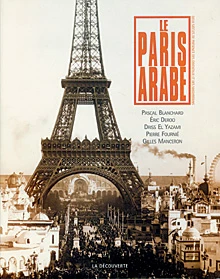
Over the last two centuries, Paris has become an important city for Arabs. A cultural crossroads, Paris attracted thousands of Arab intellectuals and still remains a center for Arab artists and writers. Somewhat resembling a family photo album, Arab Paris is richly illustrated with 7,000 photographs, iconographic documents and archival images that mirror some great moments in the shared French-Arab history. Chronologically organized, the book covers 200 years of a close historical relationship from colonization down to the post-independence period.
The book’s foreword was written by the mayor of Paris. “I salute the publishing of this book which shows the inspiring contributions made by Parisians of Arab origin to our community for the past two centuries. They have influenced, and subsequently left an imprint on, our culture, economy, society and cuisine. These Parisians have shaped our city, our history and our identity. Paris has been a homeland for many who were not born here: refugees, exiles, workers, intellectuals and artists. The photographs in the book convey the happy moments of this shared history as well as the tragic ones of the Algerian war. This book also reminds us that difference is wealth and that diversity is collective enrichment.”
A strong indicator of French-Arab historic and cultural links is the number of Parisian streets bearing the names of Arab countries, cities and monuments: Cairo Street, Morocco Street, Pyramids Street, Lebanon Street, Tangiers Street, Algiers Street, Algeria Street, Alexandria Street, Babylonia Street and Palestine Street.
Very early in the 18th century — 1704 to be exact — France was fascinated by a translation of The Thousand and One Nights. The interest continued through the century, reaching a high point with Napoleon’s Egyptian expedition in 1799 and culminating in the conquest of Algeria in 1830.
During the 19th century Paris acquired some its Egyptian architectural monuments such as the Palmier fountain with a set of sphinxes. The apartment of the French poet Victor Hugo had an Oriental chamber with cushions on the floor, hookahs and scimitars encrusted with stones. The vogue for Orientalist decoration flowered at the end of the century and arabesques made their way into Parisian residences where salons were decorated in a Spanish-Moorish style. The movement was not all in one direction; many French painters traveled to North Africa in search of inspiration and exotic subjects. The French passion for the east is seen in such paintings as Delacroix’s ‘Women of Algiers.’
By the end of the nineteenth century, Tunisia, Algeria and Morocco were under French occupation. The first group of North African immigrant workers arrived in France in 1894, having been brought to Paris to work on the first metro lines. This period also coincides with the beginnings of negative perceptions and racial stereotyping of Arabs. They were often shown as “cruel, treacherous, deceitful and lazy” in advertisements and also in children’s books.
At the beginning of the 20th century, in order to counter an increasing German threat, the French tried to rally the Muslims of North Africa and the Middle East behind them. As Turkey was Germany’s ally, the French presented the struggle as an act of liberation against the “Ottoman oppressors.” In their attempt to gain Arab support and to further their own aims, in 1916 the French created two Arabic weeklies in Paris: Al Mustaqbal and Al Tasawir. At the same time, the French government decided to facilitate the yearly pilgrimage to Makkah by eliminating much of the bureaucratic procedures that had been previously required.
During World War I, France mobilized more than 130,000 North Africans with more than 38,000 of them losing their lives. In recognition of the bravery and valor of the North African soldiers and as a token of gratitude and indebtedness, the City of Paris allocated land for a mosque and the French government financed its construction. The mosque was inaugurated in 1926 in presence of the Sultan of Morocco, Moulay Youssef. Inspired by Spain’s famous Alhambra, its minaret rises to almost 100 feet. Inside the mosque is the tomb of the first imam who, during the Nazi occupation of Paris, hid over 200 Jews in the basement, thereby saving their lives.
A look at the cultural impact of Arabs and Muslims in Paris is quite revealing. Because of the number of Arabs in Paris, many albums by Arab musicians and singers are available in France though not in Arab countries. When Arabic concerts are organized in Paris, they invariably attract a large number of fans: Oum Kolthoum in 1967, Fayrouz in 2000 and last summer, the Saudi, Muhammad Abdo. The Arabizaton of France’s culture has affected the country in many ways from music to gastronomy: couscous has become a French national dish and is considered a French favorite. In the world sports, it is often forgotten that long before Zidane’s victory in the Footbal World Cup in 1998, Algerian athletes had contributed to France’s reputation. In 1924, the Algerian Ahmed Bougherra el-Ouafi, a Renault employee, was the French marathon champion. Four years later at the Olympic Games in Amsterdam, he led France to victory and won a gold medal for France. Another example is the Algerian runner, Mimoun, who was finalist and champion of France in the Melbourne Olympic Games of 1952.
Algerian rai rhythms have entered the French national musical repertory and rai has become a symbol of French music and culture abroad. The Algerian singer Khaled who came to Paris in 1986 is now an acclaimed international star. In 1992, his famous song Didi was number one in the Top 50. Undoubtedly this was the first time that an Arabic song made the list.
Multiculturalism is also apparent in French contemporary literature. Francophone Arab writers are part of the French literary scene. This began after World War II with the Egyptian novelist Alfred Cossery who settled in Paris and published his first novel. In the 1950s, the Algerian writers, Kateb Yacine and Mohamed Dib, wrote in French. Among well-known figures identified with the Parisian literary scene is the Moroccan novelist, Taher Ben Jelloun who was awarded France’s prestigious Goncourt Prize for his novel ‘The Night of Destiny’ in 1987. The Lebanese, Amin Maalouf, enjoys great popularity and his books are bestsellers in France.
In the 1980s the French-Arab relationship became somewhat ambivalent and contradictory: on one side the Arab intellectual elite was visible more than ever with successful Arab filmmakers, news broadcasters, TV presenters, movie stars and comedians. On the other side, there was the debate on the integration of second-generation North Africans. In addition, in the 1980s and 1990s, an economic recession triggered anti-immigrant reactions and France blamed its North African population for economic troubles including unemployment and crime. More recent history is also discussed in the book, including the wave of terrorism that hit Paris in the 1990’s. French ministers and political leaders conducted a war of words against Muslim citizens and the French government withdrew its financial assistance to the Paris Mosque.