CAIRO, 2 March 2004 — Egypt yesterday launched a counter-initiative for reform in Arab countries ahead of a US mission to the region to promote Washington’s broad plan for political and economic change in the Middle East.
President Hosni Mubarak, who rejected any effort to impose foreign cultural models for change, said the Egyptian plan supported reforms that would respect Arab identities and proceed at a comfortable pace.
“If we open the door completely before the people, it will be chaos,” Mubarak warned while on a tour of Cairo international airport.
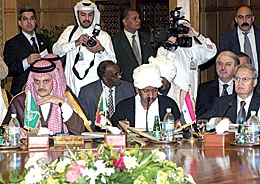
He was commenting on the Egyptian initiative that his top diplomat Ahmed Maher presented to Arab foreign ministers meeting at the Arab League, most of whose governments have rejected the US initiative.
The Arab ministers were preparing the agenda for an Arab summit in Tunis at the end of March.
Egypt’s state-run Middle East News Agency said the Egyptian draft states that Arab countries are ready “to cooperate with friendly countries” on reform on the basis of “complete equality” and without “preconceived models.” “In order to create a climate favorable to the success of the reform process... it is necessary to... settle the Palestinian question by ending the Israeli occupation and establishing an independent Palestinian state,” it said.
A separate Egyptian-Saudi document, which has Syrian support, says Arab leaders intend to “activate citizens through expanding political participation and achieving essential reforms in the political, economic, social and cultural fields.”
The proposals follow criticism from several Arab countries over a US plan called the “Greater Middle East Initiative”.
At the League meeting, the foreign ministers searched for ways to invigorate their 22-member organization to make it more formidable in the face of regional challenges, and planned to submit a proposal to their leaders to make broad changes during the summit in Tunisia.
Arab League Secretary-General Amr Moussa suggested in a paper on behalf of the League that new bodies be created — an Arab parliament, an Arab security council, an Arab court of justice and an investment bank — and that the Arab Economic and Social Council’s activities be enhanced.
Member nations offered their input. Seven Arab countries have presented written proposals, including Libya and Yemen, both of which suggested changing the Arab League to an “Arab Union.” Five other members would present their comments verbally.
All of the written submissions agreed on the need for a collective will to implement League commitments, reform relations between Arab states and ensure respect for each country’s sovereignty.
The most intriguing procedural issue facing the Arab ministers is whether to do away with the consensus required on every decision taken and getting nations to abide by what does pass.