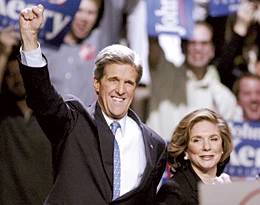
WASHINGTON, 4 March 2004 — Senator John Kerry of Massachusetts won 9 out of 10 states to grab the Democratic presidential nomination during ‘Super Tuesday,’ the largest nationwide elections before November’s presidential vote.
Kerry, 60, collected primary victories in California, Connecticut, Georgia, Maryland, Massachusetts, Minnesota, New York, Ohio and Rhode Island. Vermont went to its native son, former Governor Howard Dean, who left the race two weeks ago.
Kerry won in the nation’s two biggest states, New York and California, where Sen. John Edwards offered little competition. But Kerry’s most important victories came in Ohio and Georgia, where Edwards had counted on his southern roots and populist message to bring him victory.
Kerry has now won 27 of 30 primaries and caucuses this year, and Tuesday’s overwhelming victory kicked Edwards from the race. Edwards, 50, was gracious in his defeat, offering congratulatory speeches to the winner.
Edwards, who far exceeded expectations by lasting longer than any other major Democratic challenger, called his campaign “the little engine that could,” and then praised “my friend” Kerry for an even more impressive performance.
Edwards ran an astonishing race, with only five years in the Senate and his first elected office. He had been under pressure to end his campaign to help unify the party, but also to maintain his chances of becoming the party’s vice-presidential nominee.
Yesterday Edwards flew to North Carolina, his home state, where he announced he was stepping down.
President Bush also congratulated Kerry on Tuesday, calling him from the White House about 7:50 p.m. He told the senator that it was an impressive night, and said he looked forward to a spirited race.
“His ‘nice conversation’ with President Bush last evening was less a respite than something like the moment boxers touch gloves, the last show of formal civility before the fight begins,” observed yesterday’s Washington Post.
Political observers note there has never been such a passionate difference between the two voter bases.
The Kerry and Bush policy lines are clearly drawn, with sharp disagreements already expressed on diplomacy, Iraq, the management of the economy and such explosive issues as guns, the death penalty, abortion and gay rights.
On the personal level, the division is also clear between the onetime Texas oilman and the diplomat’s son from Massachusetts. Kerry has acknowledged his “privileged upbringing” but quickly points out that, unlike Bush, he has fought for the interests of those born without such advantages.
Today, the Bush re-election campaign begins its first blitz of $150 million worth of Republican offensive, including a “positive message” from President Bush in Spanish and English.
Next comes a new installment of “Kerry Unprincipled,” soon to be landing in 6 million e-mail boxes, compliments of the Bush campaign. Vice President Dick Cheney is also lined up for another round of talk shows aimed at shredding Kerry’s voting record on defense.
Chris Matthews, host of ‘Hardball,’ on MSNBC, said on Tuesday night the Bush campaign team “will try to pull Kerry’s (military) medals off his chest.”
But for now, Kerry must figure out how to shift his across-the-board Democratic party support to maintaining the positive attention of voters and the media, without weekly primary competitions, until the Democratic National Convention in July.
With little chance to savor Tuesday night’s victories, Kerry will shift his focus to Florida, Texas, Louisiana and Mississippi, which all hold primaries on March 9.