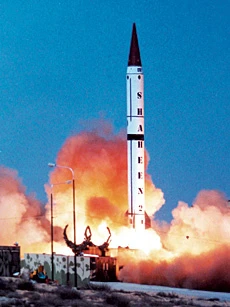
ISLAMABAD, 10 March 2004 — Pakistan yesterday test fired its most advanced missile, capable of carrying a nuclear warhead deep into archrival India.
The launch of the Shaheen 2 from an undisclosed location in Pakistan was a vivid reminder of the stakes still at play as the longtime enemies try to cement a fragile peace. The missile, with its 2,000-kilometer (1,250-mile) range, could hit Bombay, New Delhi and other major Indian cities.
“Pakistan today successfully carried out the maiden test fire of the Shaheen 2 surface-to-surface ballistic missile,” a military statement said.
Pakistan informed India in advance, and the test wasn’t likely to damage rapidly improving relations. India’s external affairs and defense ministries declined comment on the test yesterday.
The timing seemed linked more to internal Pakistani politics, with President Pervez Musharraf facing anger at home over an investigation into a black market, run by rogue Pakistani scientists, that allegedly sold nuclear know-how to Iran, Libya and North Korea.
Many Pakistanis feel the scientists have been made scapegoats, and accuse Musharraf of jeopardizing the nation’s nuclear program under pressure from the West.
Musharraf — a key ally in the US-led war on terror — announced plans to test fire the Shaheen 2 at the same Feb. 5 news conference in which he pardoned Abdul Qadeer Khan, the father of Pakistan’s nuclear program, who confessed to heading the nuclear proliferation ring.
Khan, respected as a patriot, has been under virtual house arrest since the pardon. At least six other scientists and administrators are in custody.
“This is internal politics,” said Shahid ur-Rehman, author of a widely read book on Pakistan’s nuclear program.
The test firing “was basically aimed at quieting the Pakistani people who have been accusing Musharraf of rolling back the nuclear program,” he said.
But the test caused some unease abroad. Japan yesterday said it “regrets Pakistan test firing a ballistic missile amid the international community’s efforts to prevent the proliferation of weapons of mass destruction and ballistic missiles,” the Kyodo news agency reported.
There was no immediate reaction from Washington.