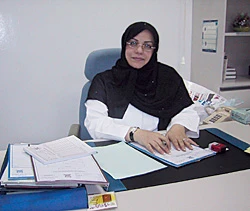
JEDDAH, 10 March 2004 — A father brings in his teenage daughter and begs, “Please save my daughter, she’s suffering.” A mother worries about her 17-year-old daughter’s changed behavior after she had run away for two weeks. A woman in her 20s is in pain after her husband lured her into his world of alcohol and drugs and then divorced her.
Stories like these are the stuff of daily life at the first drug rehabilitation clinic for women at King Fahd Hospital in Jeddah. Dr. Mona Al-Sawwaf, psychiatric consultant and head of psychiatric unit at King Fahd Hospital, supervises the clinic, which opened eight weeks ago.
The most important part of her job is to help and understand, she told Arab News. “Drug addiction is a disease, not criminal behavior. Men with drug problems have treatment facilities such as Al-Amal Hospital, so why not a facility for women where they can come to a general hospital as regular patients without any social stigma?”
Women addicts are not questioned or charged with a crime. Until recently, talking about psychiatric disorders, let alone addiction, was a stigma. But now, Dr. Al-Sawwaf finds that there is more awareness among people, especially women, recognizing the problem and seeking treatment. “We don’t have any statistics yet and we don’t know where the women get their drugs from, but from what I have been seeing, they either get them from female friends or a family member such as a husband or a brother.”
The clinic treats not just addiction to hard drugs like heroin, but the whole list starting with nicotine. “It’s heartbreaking to see youngsters and teenagers smoking sheesha in public places. Although most of society don’t approve of this, they think it is part of modern life.”
There is no research on the rate of drug addiction among women in Saudi Arabia, but from her own clinical observation Dr. Al-Sawwaf does not believe it is high. Since the clinic opened it received 12 cases for a variety of addictions including heroin, hashish and amphetamines.
“Amphetamines are a major nightmare for men and women, especially teenagers, because students take them during exams to improve their performance. However, even though amphetamines increase alertness, they reduce concentration,” she said.
Amphetamines are highly addictive. “Fifty percent of those who take it end up drug addicts, and more than 70 percent end up with psychiatric disorders starting with depression and ending with schizophrenia. Up to one-third commit suicide,” she said.
Most of the patients are in their teens to mid-20s.
Peer pressure is the main reason for drug addiction among women. Some of those who take pills get them from a friend because they have a problem at home. The friend offers them the drug saying it will help them relax and forget, and before they know it they have become addicted.
Depression can be a reason for using drugs, and drug use can in turn lead to depression.
There are two types of depression: biological — and here twice as many women are afflicted as men — and reactionary. “I don’t think depression is on the increase, but doctors and society are becoming more aware of depression. Drug-induced depression is on the rise because the use of drugs internationally is increasing,” Dr. Al-Sawwaf said.
Suicide can be one consequence of abusing certain drugs. The person may have a genuine will to kill herself, or it may be a way of getting away from extreme stress. “Suicide is not a diagnosis in psychiatry, it is part of a syndrome,” she said.
Suicide can happen by pure chance or miscalculation like taking an overdose. Internationally, the number of people committing suicide is rising. “This is due to increased stress factors such as unemployment and global events. Children are becoming more aware of what suicide means. In the past we never heard of children wanting to commit suicide, but now children as young as nine who feel depressed may commit suicide. This is happening here too. Maybe suicide rate here is less than in other countries because of religious factor. Now even in the West they are talking about religious healing and involving religious people in the psychiatric team to treat depression,” Dr. Al-Sawwaf said.
Suicide attempts are more common among women than men and more common among teenagers and young adults than adults, but the danger of successful suicide is greater among male adults. “Women tend to get away from problems by attempting to harm themselves but not committing suicide. Men, on the other hand, when they think of killing themselves, they mean it.”
In Saudi Arabia, there were 400 suicides last year — and a far more attempts.
A recent survey of more than 2,000 students in Jeddah, aged 13 to 25, by a researcher at King Abdul Aziz University, found that 65 percent of the boys and 72 percent of the girls showed symptoms of depression; seven percent of the girls admitted that they had attempted suicide (more than twice the rate of the boys). According to the survey, drug use was nearly 5 percent for both sexes, as was the rate of alcoholism.
“There is a national committee now to study reasons for suicide, people at risk, methods, and ideas on how to protect people against suicide.” The media now have a green light to write about suicide, so there is greater awareness.
What else could be done? “We don’t have specialized clinics for anger management,” Dr. Al-Sawwaf said. “I believe that would reduce crime borne out of personal conflicts as well as suicide attempts.”