
The Lonely Planet Guide Arab Gulf State states in its introduction to Saudi Arabia: "Today's Saudi Arabia retains that mystique, in part because it is so incredibly difficult to visit. The tragedy is that so many of the people who do manage to get in dismiss the entire idea of touring the Kingdom and never make any attempt to see or experience what it has to offer." I did not want to make that mistake.
When I arrived in Saudi Arabia more than four years ago, I decided that I would use every possible weekend or vacation to discover this extraordinary country.
Little did I know what awaited me. I have discovered, for myself, one of its best-kept secrets, maybe the best-kept in the Kingdom. I've hesitated to release its name and location, because it is pristine. However, its beauty and historical significance need to be shared with those who can appreciate them.
Although I have been there three different times over 18 months, I have not seen any Western or Saudi tourists in the area. I know of only one other Western person who has been there and has written about it. After retuning from my first outing, I asked various friends and acquaintances in the Jeddah area, including Saudis involved in tourism, if they had heard of it. No one knew where or what it was, or what beauty it held. If I have missed anyone in the Jeddah area who has taken the time to visit, I am certain that they will agree that it is a spectacular site.
I stumbled across the secret after more than three years of travelling through the Kingdom. One day I asked a young Howeiti who had lived in the North where, in his opinion, the most beautiful and spectacular place in the Kingdom was. Without missing a beat he said, "Dissa."
He went on to say that it was a beautiful desert surrounded by dramatic peaks, above a wadi situated in a canyon with water flowing all year round. "Dissa? Where is that?" I asked myself. The skeptic in me doubted it was true. I knew the young man was originally from that area, and we all know that the place we come from is the most beautiful place on earth. Sensing my cynicism, he offered to take me there anytime so that I could judge for myself and decide if it was or was not the most beautiful place in Saudi Arabia. I asked him to take me to Dissa the following week, and he was gracious enough to agree.
However, seeing many of the beautiful places that Saudi Arabia has to offer certainly involves a fair amount of time, and sometimes effort and paperwork too. In order to visit the famous and not so famous archaeological sites anywhere in the Kingdom, you need an authorization from the Department of Antiquities in Riyadh. Plan ahead so that you have plenty of time to get permission.
With everything in order, we set out. It is almost a thousand km by car from Jeddah to the northwest region. If you choose, you can get there in one day of hard driving. Or if you're like me, you can stop along the way and make the drive a two-day excursion. For the most part, the Saudi road network is excellent. There is a new motorway from Jeddah to Yanbu that is a pleasure to drive. After that, the roads are a bit rough. Currently, there is no hotel in Dissa for tourists. You will need to bring your tent and supplies if you want to spend a few days in the region. Dissa is located off the road that links the small port of Duba on the Red Sea to the city of Tabuk. After driving about 55 km from Duba toward Tabuk, on the main road, turn right in direction of Ashwaq, then about 30 km, left toward Dissa (GPS point : North 27.63180° - East 36.52760°).
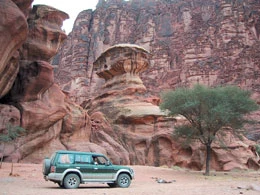
Dissa is a stunning oasis lying in a beautiful plain of sand. It is surrounded by striking sandstone mountains and dramatic peaks. You will need to have a four-wheel drive vehicle to navigate in deep sand before reaching the entrance of a red sandstone gorge. This deep gorge has the lovely Qirqir wadi running between two cliffs. Observing the dramatic landscape, you may feel that you have entered some magical realm. As you drive up in the wadi, there are numerous freshwater springs bubbling out of the rock face. You may want to stop at every corner to explore. Palm trees, lemon trees, oleander and thick high grass accompany you all the way up to the end of the wadi.
Take time to admire the rock formations in the wadi. You will discover dramatic conical rocks rising around you. Some of them are covered by dark lava crusts which resemble cakes with a chocolate frosting. Take more time to walk around, explore, and discover ancient carvings on the rock walls. There are carvings of human figures, and what appear to be camels, ostriches, and antelopes. There are magnificent specimens of petroglyphic writing, said to be more than 3,000 years old. One wonders what ancient languages or prehistoric symbols are preserved on the rocks, perhaps Nabatean Aramaic, or Dadanitic, or Thamudic, or something in the much more distant past? No one seems to have found the answers to this puzzle yet.
Looking up into the cliffs, you should see isolated tombs that are hidden behind stone walls and perched in inaccessible places. How old are they? It's another difficult question with no known answer. According to the locals, those tombs have been there for thousands of years. When you are finished exploring and heading to the village of Dissa, look on the right among the palm trees for the lonely Nabatean tomb. It is similar to those of Madain Saleh, but unfortunately located behind a fence.
One striking fact to note about Dissa is that it was a Nabatean settlement. It's almost halfway between Madain Saleh and Al-Bada. Those two settlements were the strongholds of the ancient Nabatean empire which stood astride the main frankincense route from Yemen's Hadramaut to Damascus. At that time, the Nabateans centered in Petra, which is now in south Jordan. Madain Saleh was the empire's second most important city. By levying a 25 percent charge on all goods passing through their land, the Nabateans had become very rich. Two thousand years ago, the Nabateans lived in a beautiful land with spectacular landscapes that run uninterrupted from Petra and the Wadi Rum to the Oases of Al-Ula to the archaeological wonders of Madain Saleh. Certainly, Dissa will be a significant site for tourism in the future.
While you are still in the area, an additional trek to another interesting site can be made easily. As the bird flies, the Rawafah temple is only 40 kilometers from Dissa. You will have to go back to the main road and drive north for about 20 kilometers toward Tabuk. Look for a dirt track on the right side and follow it for the next 20 kilometers. You will probably need a GPS to find the temple, which is located at North 27.75257° - East 36.22698°. There you will discover the ruins of a temple that is said to have been dedicated to Emperor Marcus Aurelius, in the year 166, after the Romans took control of the Nabateans. The temple is behind a fence, but no one is around to restrict your entrance. It is well worth the time to discover the numerous ancient writings and carvings on the rocks around the site.
Now that I have been there and seen with my own eyes the wonders and mysteries that Dissa holds, I am no longer a skeptic. It is one of the most spectacular places that I have visited in Saudi Arabia. Patrick Pierard, a renowned French guide and author in Madain Saleh had explored Dissa long before I had heard about it. You can find his book "Off Road in the Hejaz" in bookstores in Jeddah or Riyadh.
Pierard writes, "For a specialist, Wadi Qirqir deserves a month-long visit, guided by a Howeiti friend". It sure does. But if you don't have a month ahead of you, spending two days will be a real enchantment. Almost everybody in the area belongs to the Howeiti tribe. And if you want to go to Dissa, you should be accompanied by a Howeiti. You may send an e-mail to my friend in Jeddah. He will be more than happy to take you there: [email protected]