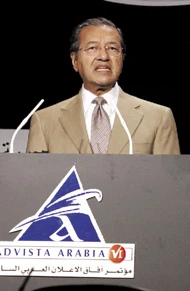
JEDDAH, 15 March 2004 — Islam is no barrier to change, former Malaysian Prime Minister Mahathir Mohamad said yesterday. Far from being an obstacle to modernization of a country, Islam had always been a force for change. “If Islam seems to be in the way of modern development, it is because we interpret it differently,” he said.
Mahathir was delivering the keynote address at the Advista Arabia yesterday, an international advertising conference held for the first time in the Arab world.
The address focused on managing change. “We can either accept the changes as they come or we can modify them. Of course, we can also initiate changes ourselves. Whatever we do, changes will take place,” he said.
Until his recent retirement as prime minister after a record 22 years, Mahathir was regarded as the unofficial leader of ASEAN.
He drew international condemnation and applause last year with a speech at the OIC conference in Kuala Lumpur comparing the achievement of Arabs and Muslims unfavorably with the achievement of the Jews.
Using the example of Malaysia, Mahathir sought to demonstrate that embracing change and holding on to traditions can go hand in hand.
In Malaysia indigenous Muslims make up only 60 percent of the population, a result of their refusal to adapt to the changes forced on the country by the British colonizers. This resulted in an influx of immigrants from China and India who were better prepared to meet the needs of a changing environment.
Mahathir said rejection of this kind of demographic change in multiethnic countries resulted invariably in endless ethnic conflict and political instability.
But since independence indigenous Muslim Malays decided to work with the descendants of the immigrants. Without losing their faith in Islam or their racial character, they adjusted and a small majority managed to remain the most powerful political element in their country.
But government also needed to change, Mahathir stressed.
Instead of returning to the old feudal system after independence, the traditional rulers decided to elect the head of state from among themselves.
This represented a pragmatic change designed to meet the special needs of a modern democratic government.
The free market presented no problem, he said, and while Malaysia had always rejected communism it was not averse to adopting some socialist elements were it thought these were useful.
Thus by picking and choosing, taking on board only what it thought would benefit it, Malaysia weathered crises that could have been fatal to other societies.
Mahathir, a controversial proponent of “strong government”, also highlighted the limitations of democracy.
Mahathir said democracy failed in many developing countries because the people do not appreciate these limitations of democracy and democracy’s potential for disruption. Democracy presented opportunities for corruption, and corruption prevented success in development.
“Because theoretically anyone can become the leader of the country, new democracies often see a proliferation of political parties. It is not unusual to have as many as 200 parties,” he said.
In Malaysia, by contrast, a coalition of race-based parties acknowledged the leading position of UMNO, the Malay majority party, making strong government possible.
That meant that the country was able to weather the Asian financial crisis of 1997 far better than many of its neighbors.
The theme of change was also picked up by Arab News Editor in Chief Khaled Al-Maeena in a speech on “The Arab World as a Brand”.
“Change not because (John) Ashcroft and (Donald) Rumsfeld want us to change, but because change is embedded in our values,” he said.
The branding of a country or a nation is like the branding of a company.
“The branding of the Arab world begins with the people of the Arab world. Creating an image is not futile. We have to begin with ourselves. We have been branded. Be tolerant, have dignity, have values,” he said.
Al-Maeena said the Arab world was not a monolith, encompassing a massive area, each with distinct subcultures. But “outside you are known as ‘Arabs’, especially after Sept. 11,” he said.
“Unfortunately, we have been branded like cattle... Yes, there are problems, there are bad people among us, there are people who need to get their act together. But by and large the Arab world is like any other world.”
He lamented that the Arab world does not have an outlet “that gives the brand of ourselves — a brand that reflects the correct perception.”
“If the product is not good, if we are not good, however much we try to whitewash our activities, it does not matter,” he said.
The branding of a people or a country is exactly like branding the image of any other product or company. “So if we see that the Arab world as a company and its people as products, and then try to evaluate and re-evaluate, I think we will come to terms with ourselves,” Al-Maeena said.
Where the Arabs fall short is in terms of public relations, he said. They have no answer to the CNN or the BBC. Millions of dollars have been spent on “foolish stations that do not offer anything except garbage, and then we complain about the Western media bias.”
But there was no such thing as the Western media. There is the American media, “which is really out to get us, there is the British media, the European media. Let us not lump all under one umbrella.”
“A majority of the Arab people want to live in peace, dignity, change for growth and development,” he said. “Right now, the branding of the Arab world, and especially in the light of the past few months, is that the Arab world is absolutely bent on destroying, and does not know how to coexist with others peacefully. (But) a majority of the Arab people want to live in peace, dignity, change for growth and development,” he said.
Al-Maeena was followed by Philip Skaff, the chief executive officer of Grey Worlwide Middle East, who said Arabs have to match their past achievements by actively engaging with the present.
“One Arab getting a Nobel Prize will do more for the standing of Arabs in the world than a thousand advertising campaigns,” he said.