
ALKHOBAR, 15 March 2004 — Speak to most adults about Civil Defense and their eyes glaze over. No matter how important this topic may be, people would rather ignore it. That’s really too bad because we all know of people who could have avoided serious injury or worse if they had understood safety issues in greater detail.
With that in mind, Alrashid Mall’s management chose to pitch last week’s Civil Defense Exhibition to the younger generation. The exhibition was mounted to recognize the International Day of Civil Defense on March 1. For the 10 days of the exhibit, 5-10 schools visited Alrashid Mall each morning for briefings on Civil Defense themes from fire safety to the role of paramedics.
“We believe that educating students about the importance of safety and security in our society will help them recognize the value of these topics throughout their lives,” said Nizar A. Bakhurji, marketing manager, Alrashid Mall. “We have tried to introduce the subject in innovative ways to the entire community. We have been getting about 20,000 visitors daily to the mall and the Civil Defense competitions in the evening were well attended. Participants had to correctly answer questions on Civil Defense issues in order to win the prizes. On Thursday night we gave away a car as the grand prize in the competition. We are taking the subject of Civil Defense very seriously, as we believe it has great impact on the community.”
According to Bakhurji, 22 organizations participated in the Civil Defense exhibition. Some groups such as the Armed Forces Hospital went out of their way to ensure that women were included in the event.
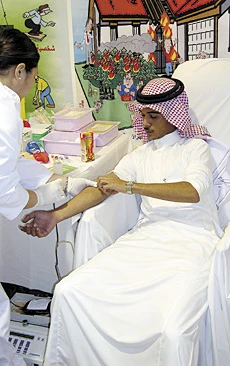
“We set up a separate medical unit for men and women where they could check their blood pressure and be screened for diabetes,” said Salman Saud Zukaiby, supervisor blood donation, Dhahran Armed Forces Hospital. “As part of our contribution to the Civil Defense effort, we set up teams here to collect blood donations. We collected 50 units of blood from men, but despite our best efforts, no woman has been willing to give blood. This shows that there is still a way to go to promote awareness of the importance of blood donation throughout Saudi society.”
Zukaiby explained that the Kingdom has a national blood bank and hospitals across the Kingdom work together to ensure that this blood bank is prepared to handle all requirements for blood transfusion. A+ and O+ are the most common blood types in the Kingdom so the most blood is needed of these types. However, there is still constant demand for all blood types. There is a special tracking system for blood stocks and if any blood type is running low at the blood bank this situation can be recognized and rectified before it reaches the critical point.
Naif Abdullah Al-Saab, a 23-year-old government employee, had just finished donating 450ccs of blood. He stated that the entire procedure took less than 30 minutes and it hadn’t bothered him at all.
“This is the first time I donated blood, but I would do it again if I was asked,” said Al-Saab. “My friends are here with me at Alrashid and since I mentioned that I wasn’t afraid to donate blood, they encouraged me to give it a try. In fact, they are next to sit in this chair. This is one way that ordinary people can help others in need and we should all participate in such activities.”
Another activity that everyone should be eager to engage in is fire safety. Rafat Shalem, installation and maintenance technician, Al-Otaishan Company for Fire Safety, said that at the exhibit there had been many inquiries from the public about fire safety equipment.
“We are speaking with people about the importance of installing smoke detectors in their homes,” Shalem said. “Many people don’t know what smoke detectors are or they believe that these devices are only for the workplace. This is a misconception. Every home should have smoke detectors in the bedrooms and the kitchen. Homes should also be equipped with a fire extinguisher. The average home fire extinguisher costs SR50. This is a small expense that can bring great benefit.”
Shalem was certain that people took the advice he gave them seriously and he thought it was a pity that it wasn’t possible to sell the fire safety equipment to people on the spot. He felt this would be the most effective way to get more fire extinguishers and smoke detectors into people’s homes. He also said that while companies generally have a designated group of employees trained in the use of fire extinguishers, there was no such course offered for the general public. People often had their first experience using a fire extinguisher when they were actually putting out a fire at home. Shalem pointed out that this wasn’t the best time to learn to use the device and that perhaps courses could be offered in high schools so that people would become more familiar with handling safety equipment. Surprisingly though, while Shalem’s company-provided hostel in Saudi Arabia is equipped with fire safety devices, at his home in Egypt he doesn’t have any. He said: “We don’t use such equipment in Egypt.”
Another company promoting fire safety in a different way was the National Gas and Industrial Company. They were handing out fliers in English, Arabic, Urdu and Tagalog about the procedures to follow if the odor of liquid petroleum gas (LPG) is detected in the home.
Speaking on behalf of the National Gas Company at the exhibition was Adel Al-Khudair, marketing manager. He explained that the company was encouraging families to switch to permanent LPG tanks installed in their courtyards rather than continuing to use the smaller portable tanks.
“The large tanks have their own special safety valves which are much safer than the small tanks,” said Al-Khudair. “It is true that we don’t have a large number of accidents with small LPG tanks but nevertheless the risk is always there. The big tanks hold from 450 to 4,000 liters and LPG trucks come directly to the home to refill the tanks. This gets rid of the unpleasant chore of lugging around the small LPG tanks and eliminates the risk from connecting the tanks by temporary means — many of which are quite unsafe. The cost is reasonable, as the purchase price of the 1,000-liter tank is only SR4,000. We think this is a small price to pay for a family’s peace of mind.”

