JEDDAH, 15 March 2004 — The traffic in Jeddah’s Tahlia Street was as usual, cars speeding along, weaving from one lane to another. Suddenly there was a distinct thud. It sounded as if a car had run into the back of another but there was no sign of it; cars continued to drive on. I had just come out of a bank. Then a Bangladeshi cleaner outside the bank began shouting to a colleague, pointing to the road. I looked but saw nothing. He stopped shouting as suddenly as he had begun and returned to cleaning the windows.
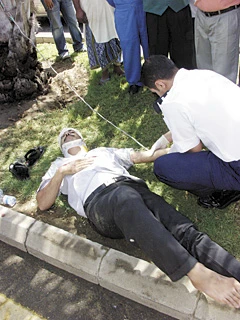
Then I saw a man, lying on the central reservation, writhing in agony, blood pouring from his head. He had been hit by a GMC Suburban that had stopped a few meters down the road. At the same moment as I saw the injured man, so did three or four others who rushed over; a passing police car stopped to investigate. One man was on his mobile phone straightaway phoning for an ambulance; another picked up the man’s wallet and various papers to keep for him but the policeman did not seem particularly bothered about the injured man. He was more interested in talking to the driver of the GMC.
For a few moments I stared from across the road, helpless, knowing nothing about first aid, just praying that an ambulance would arrive quickly. Then I saw that the others had all gone to join the conversation with the policeman around the GMC. The injured man was left lying there as if he did not matter.
The traffic continued to speed by, unaware that anything had happened. He just lay there, all alone, writhing in agony. It was as if no one in the world cared.
Shocked and angry, I rushed across to do what I could. It seemed important that he should know that he was not all alone. Quite apart from the blood pouring from his head, it looked as if his leg was broken and possibly other parts of his body injured. I told him not to move but he was obviously in considerable pain. There were no screams, just quiet moans; he was probably in shock. He was having difficulty in breathing. He kept taking deep breaths. I knelt down by him and talked to him, telling him that help was on its way.
He told me his name was Niaz — at least that is what it sounded like — and that he was from Pakistan. He was young, probably in his late 20s. I later discovered he had been sent by his boss to transact some business at the very bank I had just come out of.
Almost as soon as the policeman and others saw me kneeling there, talking to the injured man, they came back, but none of them bothered to talk to the man or try to reassure him, although one man who had arrived on the scene produced a bottle of water, handing it to me to give to the young man. He waved it away. It was the only act of kindness I saw.
Then in a surreal moment, he managed to pull out his mobile and telephone his boss to tell him that he had been run over.
Suddenly there were people everywhere. Cars stopped. Men came running over. But most were not there to help; they were there to gape. They flocked to the scene like ghouls. They stared at the injured man with evident horror, and after hanging around for a few moments to see if anything else might happen, they departed into the day.
Eventually the Red Crescent ambulance arrived, bringing with it a cocoon of order and focused activity. Wordlessly the two paramedics went about their duties and stabilized Niaz, apparently injecting a painkiller that calmed him down and fitting a neck-brace and drip.
Correctly, they wore rubber gloves to treat the bleeding patient, but then, shockingly, threw the used syringe on to the grass verge, not even bothering to put it back into its plastic cover.
By chance, our senior reporter had also seen the activity and stopped to investigate. A few photos later, the police focused squarely on the alleged illegality of photographing the incident.
Surrounded by police who were evidently more interested in the wonders of a camera that did not use film, they ignored both the GMC driver and the traffic causing congestion around the ambulance. The reporter was harassed for an assortment of documents and permissions and generally prevented from recording the incident.
Meanwhile, the traffic had accumulated to the point where there was a serious risk of a follow-up accident as drivers craned to see the show provided by an inert body and the argument between reporter and police. That the police were not successful in preventing report or photographs is evident. That there was not a second accident while their attention was focused on unnecessary paperwork and the prevention of information of genuine public interest and not on creating a safety zone around the scene of an accident is pure fluke.
I left the scene, my hands and clothes covered with blood, still praying that the wounded man would be all right. Our reporter left with his documents and camera, having declined to part with either.
We learned that some hours later, Niaz discharged himself from the hospital he had been taken to. Whether he was well enough to do so, we do not know. We now know nothing more about him or his condition.
— Additional input by Roger Harrison