JEDDAH, 17 March 2004 — There will be no letup in the Kingdom’s fight against terrorism, Foreign Minister Prince Saud Al-Faisal said yesterday, a day after security forces gunned down two terror suspects including a leader of the Al-Qaeda network in the Gulf region.
“Saudi Arabia has announced it is fully pledged to eradicate terrorist activities in the country and to cooperate in the international arena with everybody who is fighting terrorism,” Prince Saud said when asked to comment on Monday’s shootout in Riyadh that killed the two militants.
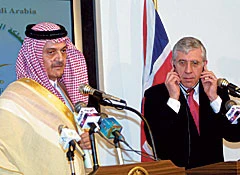
“We are happy with the successes,” the prince told a news conference with visiting British Foreign Secretary Jack Straw in Riyadh. “We know the successes haven’t finished the issue, but we will continue on the same course,” Prince Saud said.
The Interior Ministry identified the militants killed in Riyadh on Monday as Khaled Ali Haj, a Yemeni, and Ibrahim ibn Abdul Aziz Al-Mezeini, a Saudi. A ministry official, speaking on condition of anonymity, described Haj as the “most dangerous” Al-Qaeda operative in the region.
Haj ranked third on a 26-strong list of most wanted suspected militants alleged to have links with last year’s suicide bombings in Riyadh that killed 52 people. He once served as a bodyguard to Al-Qaeda leader Osama Bin Laden.
A US counter-terrorism official said Haj’s killing was a “major, very significant blow” to Al-Qaeda. “This guy was involved in ongoing terrorist planning and plotting,” the Associated Press quoted the US official as saying on condition of anonymity.
The British foreign secretary commended Saudi Arabia for its battle against terrorism.
“We greatly value the determination of Saudi Arabia and its government to fight terrorism on all levels and we’re seeking to deepen our cooperation there,” Straw told reporters after meeting with Saudi leaders.
Straw met with Crown Prince Abdullah, deputy premier and commander of the National Guard, and Prince Sultan, second deputy premier and minister of defense and aviation, before flying to the UAE.
The two countries expressed their concern over the deteriorating situation in Iraq. The Saudi minister said his meeting with Straw helped him “explain Saudi Arabia’s position regarding the situation in the Middle East and Iraq.” “Jeremy Greenstock, Britain’s representative in Iraq, gave us a detailed account of the situation in Iraq,” Prince Saud said. “Both of our countries are ready to work for the stability and prosperity of Iraq.”
The British minister denied his country was proposing a separate plan for Middle East peace but stressed London’s efforts to revive the road map for Middle East peace.
“We have discussed prospects of cooperation between Arab countries, the European Union and the United States to implement the road map. We are happy with the ideas presented by Mr. Straw in this regard and hope that it will lead to more cooperation in this area,” Prince Saud said.
Prince Saud acknowledged that he also discussed the issue of Saudi dissidents in Britain. “We have to settle all outstanding issues between the two countries,” he said without elaborating.
Referring to political reforms in the Kingdom, Prince Saud said: “Reforms are essential for citizens and we are looking into this matter with utmost interest.”
Greenstock, meanwhile, denied reports that a large number of Saudis were fighting alongside Iraqi guerrillas against the occupation forces. “The number of Saudis who infiltrated into Iraq from neighboring countries will not exceed tens,” he said. He said the foreign fighters included Afghans, Sudanese, Yemenis and Syrians.
Greenstock said there was good coordination to reinforce security on the borders with Iran, Kuwait, Saudi Arabia, Jordan and Turkey and to some extent with Syria.
— With input from Khaled Batarfi, Abdul Aziz Al-Hindi and agencies.