
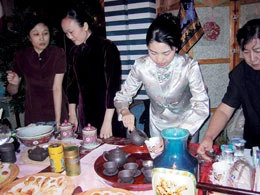
Saudis certainly enjoy their Arabic coffee but they are equally passionate about tea. Tea has been popular in Saudi Arabia, particularly along the Red Sea, for centuries. It was very likely introduced by pilgrims coming for Haj and bringing their favorite foods and drinks with them.
A celebration of tea organized recently by the Women's Welfare Society at the Equestrian Club in Jeddah, 'Tea from Around the World,'focused on the origins of tea. The purpose of the event was to make money for building a new boys' orphanage. Different kinds of tea as well as ways of preparing and serving it were highlighted. In addition to traditional Saudi tea, the Chinese, Japanese, Turkish, Russian, Sir Lankan, Indonesian, Moroccan, Lebanese Greek and British consulates also demonstrated how their countries serve tea. Items related to tea such as chinaware, table cloths and accessories plus food served with tea, such as chocolates and biscuits, were also sold. In addition, handmade items by local people and by women living in the charity homes supported by the Women's Welfare Society were on sale.
Tea is the second most popular beverage in the world. Only water has a higher rate of consumption than tea. It is estimated that between 18 and 20 billion cups of tea are drunk daily. Tea is made from the processed leaf of a plant whose Latin name is Camellia sinensis. Though tea contains caffeine, a six-ounce cup contains less caffeine than a six-ounce cup of coffee. Tannin compounds and essential oils are responsible for the flavor of tea, the color, the astringency (dryness) and the delightful smell. Besides its soothing effect, many believe that tea is good for health and research has confirmed this. At present tea is grown in more than forty countries with Sri Lanka and India producing 90% of the total output. China is the homeland of tea and all tea plants come either directly or indirectly from there. The habit of drinking tea spread to Japan from China in the 6th century but it was not introduced to Europe until the 17th and 18th centuries. Chinese tea is classified into five categories according how it is processed. Green tea is the variety which keeps the original color of the leaves without fermentation during processing. Black tea is fermented before baking. Wulong tea represents a variety half way between green and the black teas, being made after partial fermentation. Compressed tea is compressed and hardened into a shape to ease its transport and storage. The fifth kind of tea is scented tea, made by mixing fragrant flowers with the leaves during processing. The hostess at the Chinese counter graciously poured jasmine tea.
At the Russian counter, there was a hostess with a decorative porcelain samovar. I remember when my grandmother served tea from her silver-plated samovar, which came to her from her mother; it now belongs to my aunt who used it until about 15 years ago. Samovar is a Russian invention of the mid-18th century that is used to boil water for tea. It is made of metal, including iron, copper, brass and bronze. The design elements and embellishments were limited only by the resources, imagination and artistry of the maker. A samovar was considered a staple in every Russian home. The steaming samovar embodied, and still does, Russian comfort and hospitality. Samovars are urns in which water is kept boiling since charcoal or wood is burned in a vertical pipe through the center which heats water. Later it became electric. On the top of the samovar a small teapot was held that provided strong tea brewing. This tea is usually diluted with hot water from the samovar.
In Japan, tea takes on a more formal yet intimate significance. The Japanese tea ceremony is a highly structured way of preparing powdered green tea in the company of guests. It is a culmination of the union of artistic creativity, sensibility to nature, religious thought, and social interchange. A full-length tea ceremony involves a meal and two servings of tea and lasts approximately four hours, during which the host engages his whole being in creating an occasion designed to bring aesthetic, intellectual and physical enjoyment and peace of mind to the guests. Although tea serving in Saudi Arabia is not as structured as in Japan, it is still a welcoming gesture and can be an elaborate occasion for friends and family to gather around cups of tea.