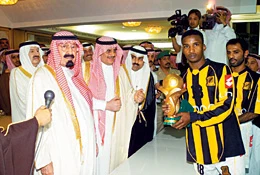
RIYADH, 27 March 2004 — Crown Prince Abdullah, deputy premier and commander of the National Guard, will not attend the upcoming Arab summit in Tunisia. The Kingdom’s delegation will instead be headed by Foreign Minister Prince Saud Al-Faisal, the Saudi Press Agency said yesterday.
“The delegation will include Water and Electricity Minister Ghazi Al-Gosaibi and Finance Minister Ibrahim Al-Assaf,” SPA said, citing a royal statement.
In Manama, the official BNA news agency said Bahrain’s Prime Minister Sheikh Khalifa ibn Salman Al-Khalifa, and not King Hamad ibn Issa Al-Khalifa, will lead the country’s delegation to the summit.
Ahead of the summit on Monday, foreign ministers held talks in Tunis yesterday. They were marked by differences over a plan for wide-ranging political reforms in the Arab world. “An Egyptian document containing ideas and plans for the Middle East was presented and sparked discussions that were sometimes stormy,” one official said, adding that “the majority wanted it to be adopted by the summit.”
“But some countries, such as Syria and Lebanon, believe it is not necessary to present a reform plan now, when the priority should be the Arab-Israeli conflict.”
Adding to the tension was the bitter memory of the assassination of Hamas leader Sheikh Ahmed Yassin on Monday by Israeli forces.
Disagreements emerged at an informal gathering of the ministers on Thursday, prompting some delegates to suggest the summit might be postponed.
Algerian President Abdelaziz Bouteflika later told the Al-Arabiya satellite television network that he had heard officially that some countries wanted the summit to be postponed.
But Arab League Secretary-General Amr Moussa insisted the summit would go ahead as planned.
Arab states opposed to discussing reforms maintain that the summit should limit itself to adopting a firm position on Israel that demands an Israeli withdrawal from Arab territory occupied since 1967.
But countries backing the Egyptian document insist that settling the Arab-Israeli dispute must “go hand in hand with reform.”
In his opening remarks, Moussa harshly criticized Israel’s targeting of Yassin and accused the Jewish state of blocking Middle East peace efforts.