
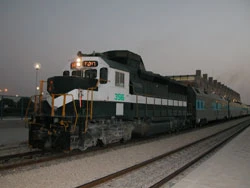
My exhilaration rose as I sat in the family section of the speeding train, on my way from Riyadh to Dammam. This was my first time traveling by rail in Saudi Arabia and the first time I ventured out on a journey alone. The 449 kilometer trip would put me at my destination in four and a half hours, stopping only twice at Abqaiq and Hofuf.
The seats were comfortable for the SR40 economy fare, although for another SR20 I could have had a better sofa seat and some carpet on the floor in first class. Either way, the view was the same, a monotonous streak of sand which blew around us as the train made its way east.
The view inside was more absorbing. There was an Indian man reading a VCR manual, but no box was in sight. "I'm a doctor working in Al-Ahsa. I never get time at home, so I'm reading my manual here," he told me.
There were small Saudi boys playing with toy guns and running amok on the train, annoying those who were trying to sleep. An old woman kept mumbling something and calling out a name. "My mother is blind," a young Saudi man explained. "I have to assure her every few minutes that I am close by."
A vendor with tea, coffee and a variety of treats was doing his rounds. The children rushed over to buy chips and chocolates, later leaving their litter throughout the train.
"Hello. My name is Muhammad," an elderly Saudi man on my right said. I had watched him read a notebook marked "cash book". I thought he was probably calculating his wealth, but as it turned out he was only increasing his English vocabulary. "I love English, and I have a list of new words in my notebook."
Muhammad turned out to be a mine of information. He told me that he first took the Saudi train 40 years ago. "The trains back then were not as comfortable. They had wooden seats and no air-conditioning. You had to bring your own food and if you opened the windows you got covered in dust. They were also very slow. A train from Hofuf to Riyadh took almost seven hours, now it takes only two."
The existing Saudi Railway, which runs only between Dammam and Riyadh, was inaugurated in 1951 by King Abdul Aziz.
The original railway line was 556 km long. In 1980's a high-speed direct line was constructed, cutting off over a hundred kilometers. Around 800,000 passengers ride the passenger trains annually, and the old line is still used to transport 850 million tons of cargo per annum.
Most passengers find the railway services comfortable, affordable and convenient. "The train is a little slow compared to other modern trains around the world," said Junaid, an American computer analyst who rides the train from Riyadh to Dammam every month. "But the schedule is convenient." His wife, Shazia had only one complaint: the bathrooms. "They are dirty and I usually avoid them."
There has been growing public demand for the railways to extend its services to other cities, especially Jeddah, Makkah and Madinah. The Saudi Railways Organization is hard at work on plans for the expansion and has appointed financial and technical advisors.
The plan includes an East-West land bridge connecting Dammam to Jeddah within the next few years and railway services linking Makkah via Jeddah and Madinah with Yanbu, called the Makkah-Madinah Railway Link. This 570 km line would help the millions of Umrah and Haj pilgrims each year.
In addition, cargo lines would run between the major industrial towns and those with valuable minerals; like the 115km Dammam-Jubail line and the 1,300 km North-South lines between Al-Jalamid (which has huge deposits of phosphate) and Al-Zubairaha (rich in bauxite deposits) to Jubail via Riyadh. International container traffic for countries like Bahrain, Qatar and Kuwait is also under consideration.
As we drifted closer to our final destination, the Bangladeshi cleaner was working hard to clean the carriage. He makes SR300 a month yet puts in 12-hour days. I asked him if first class was easier to clean than economy. "There is no difference in the amount of dirt. Whichever class has more children, will have more litter," he said.
Railways are an integral part of the economy and public infrastructure for any country. Saudi Railways is already over fifty years old, but at last it looks set to be moving in the right direction. For more information you can visit the website at www.saudirailexpansion.com