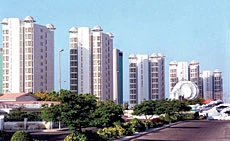
JEDDAH, 15 April 2004 — The boom in the construction industry continues to change Jeddah’s skyline, with a number of high-risers now dotting the Corniche and the Balad.
High-rise buildings on the Corniche are mostly hotels and apartments. Aside from the international hotels that have sprung up in the last few years, many new constructions are in progress.
Elsewhere in the city, existing landmarks include the Islamic Development Bank and the National Commercial Bank.
Very few high-rise buildings adapt features of traditional architecture, mainly due to modern construction materials which are cheaper and easier to use. “New materials are forcing us to adopt new styles of architecture and design,” says Talal A. Samarkandi, a Saudi architect who worked with the Jeddah municipality before going private. Samarkandi is an active member of the Al-Umran Society, a Kingdomwide body of architects.
Not all traditional designs are necessarily Islamic in any meaningful way, though some modern architecture adapts Islamic designs because they tend to strive for equilibrium in design, materials and cost.
“I’m of the opinion that traditional designs blended with Islamic architecture can help meet today’s needs to protect nature and environment,” he says.
However, most young Saudi architects are influenced by Western or Mediterranean ideas or American architects. “The influence is so deep-rooted that we’ve any number of White House-type structures across in the Kingdom’s major cities,” Samarkandi says.
The influence can be seen even in Makkah, where buildings constructed in the 1980s were mostly designed by foreigners. It is only in the recent past that Saudi architects have replaced them, but they too are addicted to a derivative international style that has more in common with Las Vegas than the traditions of the Arabian Peninsula.
There are more than 1,300 Saudi professional architects across the Kingdom — 300 to 400 in Riyadh, 250 in Jeddah and 120 in Makkah.
Land in Makkah is the most expensive in the Arab world, Samarkandi asserts. “It costs as much as half a million riyals per square meter opposite the Holy Haram.”
Yahya J. Al-Najjar, design consultant at the Alkhobar-based DesignPlus company, agrees with him. “Land is the most expensive in Makkah, followed by Madinah, Riyadh, Jeddah and Dammam in that order.”
Jeddah’s most expensive areas are in the old city and along its 80 km Corniche.
The skyline would have changed even more dramatically had the Sept. 11 attacks not put a number of real estate projects on hold. But with so much Saudi money returning from the West, there is still a boom in the construction industry, said Ayedh ibn Farhan Al-Gahtani, executive managing director of the Alkhobar-based Al-Oula Development.
Annual investment in the real estate development business exceeds SR10 billion.
The winning designs in a recent competition by the Arriyadh Development Authority for a sustainable Saudi house found little exposure in the media. But the challenge the architects responded to was very real: How to build well-designed affordable homes taking account of Saudi traditions and also responding sensitively to their environment.
On the evidence of current construction projects here, that is still a distant dream. The homes that rise with breakneck speed on empty lots in this city continue to be flashy on the outside and poky on the inside, with little evidence that things are changing.