
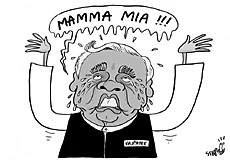
NEW DELHI, 14 May 2004 — The electoral verdict in India has upset all calculations, with latest results suggesting 188 seats for the BJP-led NDA, as against the predicted 240 seats for the alliance led by Prime Minister Atal Behari Vajpayee. So where did it all go wrong?
Clearly, the answer does not lie in the refusal by the Indian voters to buy the BJP’s “feel-good” and “India Shining” campaign, which promoted Vajpayee’s leadership as the only option against that of “foreign-born” Congress leader Sonia Gandhi. If the Congress leader traversed the length and breadth of the country appealing to the people, BJP stalwarts did the same. But as results confirm, Mrs. Gandhi’s appeal carried importance for the people, and they rejected NDA leaders. Why? The NDA lost ground primarily for two reasons. First, its claims of progress made under Vajpayee’s leadership had little weight among the economically weaker sections of society, who constitute the overwhelming majority in urban as well as rural areas. The country’s “newly” acquired nuclear stature or the upswing in its ratings in computer technology meant little for these sections, the majority of whom are barely literate and are not even sure their next meal is going to come from. Telugu Desum Party’s loss of power in Andhra Pradesh and the BJP’s failure to sweep the Lok Sabha seats in Gujarat are strong indicators of this fact. Computer technology and a religious agenda resting on Hindutva jargon failed to convince these sections in both the states. Against such campaign, Congress criticism of NDA as being responsible for the economic “mess” the country is in and the rising number of unemployed people convinced them, for it touched their problems.
In Delhi, the success of Congress rests on poorer sections expecting the party to pull them out of their economic woes. The root causes of their economic problems are increasing costs of living and decreasing sources of income. The BJP’s dismal performance in Bombay also rests on economic grievances of poorer sections associated with the fishery business. The major difference between pollsters’ predictions and the final results indicates that minimal importance was given to the opinion of aggrieved people of rural and urban areas.
The second cause of the NDA’s defeat lies in communal agenda of the BJP and its right-wing partners. The Gujarat carnage not only stained the BJP’s image globally, but it also fractured its standing and that of its “secular” allies at home. There is a remarkable link between the fact that an alliance with the BJP proved costly for the National Conference in the Jammu and Kashmir Assembly elections (October 2002) and the TDP’s miserable defeat in Andhra Pradesh during the present Assembly as well as Lok Sabha polls. An alliance with the BJP has meant that AIA DMK failed to win even a single seat in Tamil Nadu. The implications are obvious: The majority of Indian voters are not at all keen to promote events like the Gujarat riots and the BJP’s Hindutva agenda. A split in anti-BJP secular votes was prevented by the decision of Congress to align itself with the DMK in Tamil Nadu and the leftist forces in Andhra Pradesh. Had Congress not opened itself to the idea of such alliances and the formation of a coalition government, the verdict may not have favored it. Basically, the Congress was not interested in repeating the 1999 fiasco.
During the late nineties, in less than three years, India went to polls three times (1996, 1998 and 1999). Each time, Congress was guided by the assumption that it would be able to return to power on its strength. Despite not securing a majority in 1999, Sonia Gandhi staked a claim to form the government, hoping that other secular parties would support her bid. This political mistake allowed the BJP to put its Hindutva agenda on the backburner and secure the needed support to form the government and stay in power until now. Wiser after the 1999 fiasco, this was the first time that Congress went to polls keeping its options open to form a coalition government and entering into alliances. Perhaps, had Congress entered into an alliance with the Samajwadi Party in Uttar Pradesh, it would have fared even better. However, it is important to remember that Congress fought against the Left Front in West Bengal and in Kerala also. Their rivalry at the state level has not eliminated their option of uniting at the center to keep the BJP out of power.
Overall, in any case, the victory of Congress rests on the average Indian voters’ decision to defeat the BJP’s economic and communal agenda. Hats off to the secularism of the Indian voters.

