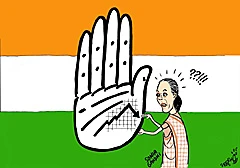
NEW DELHI, 18 May 2004 — At the end of a tumultuous day, it emerged late last night that Congress party leader Sonia Gandhi will be meeting President A.P.J. Abdul Kalam today and will be sworn in as prime minister tomorrow.
This was announced as the stock market crashed and her Communist allies opted not to join her coalition.
“I am announcing this today that she will be taking the oath on the 19th,” said A.B. Bardhan, leader of the Communist Party of India which is allied with Sonia’s Congress.
Speculation had mounted that 57-year-old Sonia would decline the prime ministership after the Communists said they would only support, not join, the government and the defeated Hindu fundamentalists said they would boycott her swearing-in because she was not Indian by birth.
“One TV channel tried to spread the rumor. It is totally wrong,” Bardhan told a packed news conference at Sonia’s residence in central New Delhi.
Bardhan said that leaders of all Sonia’s allies rushed to her home after the rumor had spread. For two-and-a-half hours, she was closeted with her allies in her house while all 145 newly elected Congress MPs waited on the lawns outside for “an important announcement”.
At the end of the meeting, party leaders Manmohan Singh and Pranab Mukherjee trooped in and announced that Sonia would be meeting President Kalam today to formally seek permission to form the new government.
Leftist parties, with more than 60 of Parliament’s 545 seats, decided not to formally join Sonia’s Congress party and its allies in the coalition.
The move was expected, because the leftists compete directly with Congress in their state strongholds. But they also bitterly oppose the return to power of the ousted Hindu fundamentalists, which would be the inevitable result if Sonia falls.
So they have pledged to support her from outside, voting with Congress on most issues, including confidence motions and drafting a common agenda. It is common in India for parties to support a government from outside a formal coalition.
Investors fear the leftists, led by the Communist Party of India (Marxist), the third largest party in Parliament with 43 seats, will block or slow key reforms in Asia’s third-largest economy, especially privatization of bloated state firms.
Manmohan Singh, the father of India’s economic reforms more than a decade ago, stepped in quickly to reassure investors after the share market crashed.
“There is no doubt in my mind that we will persist with the reform package... which strengthens the climate for enterprises in our country, promotes savings and at the same time is seen to be addressing the problems of agricultural stagnation, problems of jobless growth,” he told Reuters.
A few hours earlier, Communist leaders urged increased farm subsidies, the return of some import restrictions and the axing of the privatization ministry.