
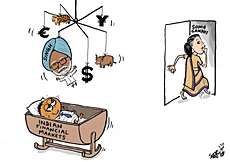
NEW DELHI, 21 May 2004 — Amid speculations raised by Congress leader Sonia Gandhi’s decision not to accept the prime minister’s post, it has to be hailed as a deft masterstroke which has removed apprehensions held earlier about her being political naïve. One small, simple decision by the same lady, whose leadership potential was earlier doubted even in media circles, has led to her being hailed as one above other politicians in the fray. The decision has not only raised Sonia Gandhi’s political and moral stature in the media world and the newly formed Congress-led United Progressive Alliance, it has humbled the politicians who have indulged in campaigning against her.
With her having decided not to become the prime minister, it has defeated plans being made by BJP about launching a “movement” against a foreign-born citizen assuming the prestigious position. BJP leaders are now left deliberating over what should be their next strategy, with the wind being taken out of what they viewed as their master plan.
Whatever is the mid— or long-term strategy of Sonia Gandhi, for the moment she has removed speculations entertained in national and international media about her continuing the Nehru-Gandhi’s dynastic inclination for the premiership. By specifying that she had never desired to become the prime minister and that serving the Congress party and the nation were always her priority, she has raised her stature higher than what it was earlier. Her image has been elevated to the position of someone who is placing party and nation’s interest above that of her own personal political ambitions.
Perhaps, when Sonia took the crucial decision, she did not visualize that with it, the media, analysts and politicians supporting her, would elevate her to such a great height. This is one side of the story limited to laurels that the decision has won for Sonia.
The other is the political deftness with which the decision has been taken. If Sonia Gandhi, as revealed by her son Rahul, was not interested in becoming the prime minister from May 13 itself, what took her so long in revealing the same? Whether she deliberately delayed the move or some other reason compelled her to take this time, had she instantly announced the decision, it may not have been easily accepted by allies. The decision was announced after several meetings with allies and supporters of Congress were held, they were taken into confidence and she was confident that they would not have any objections to a Congress-led government, whoever the prime minister.
Timing of the decision, before Congress staked claim to form the government, led to another ally — the DMK — announcing that it would join the government. This ally had earlier voiced reservations about being led by a foreign-born prime minister. And till Sonia Gandhi was being viewed as the prime minister in waiting, DMK’s stand was that it would support the government from outside.
Had Congress fought the polls by projecting Dr. Manmohan Singh as the prime ministerial candidate, in all probability, the party would not have fared as well as it has. He is former governor of Reserve Bank of India, a specialist in the field of economics and is not recognized as a man of the masses. He is an extremely quiet and refined gentleman, and is known as a “very clean and honest man.”
In selecting Singh as the Congress choice for prime minister, Sonia Gandhi was probably guided by three crucial factors. One is his clean image. Secondly, he is a Sikh, the first person hailing from a minority community to hold the position. Till date, only Hindus held this post. This strengthens Sonia’s claim of her working hard to strengthen the secular foundations of the nation and defeat the communal forces. Thirdly, the Congress’ image suffered among the Sikh community when then Prime Minister Indira Gandhi launched Operation Blue Star (1984) that led to Indian troops entering the Golden Temple at Amritsar, the most sacred Sikh shrine. Indira Gandhi’s assassination by a Sikh bodyguard during the same year led the Congress members to indulge in riots targeting the Sikhs.
Now, selection of a Sikh to hold position of the prime minister may be viewed as a part of much-awaited damage control exercise being taken by Sonia Gandhi to enhance credentials of the Congress among the Sikh community.
Also, despite being a quiet, withdrawn person, Manmohan Singh is known to hold friendly ties with certain crucial left leaders, particularly Harkishen Singh Surjeet. With Manmohan Singh in power, Sonia can at least be assured that he will maintain good relations with a key ally.
Whatever may have been Sonia Gandhi’s motives that prompted her to relinquish the opportunity of becoming the prime minister of India, the decision definitely stands out as a political masterstroke.

