
Some keep it locked in a drawer of their bedside table, others keep it wrapped in silk in a safe place around the house, taken out only on commemorative occasions to show reverently to guests, and others still, in moments of solitude and reflection, hold it in the palm of their hand, gently passing their fingers over it, much in the manner of a man stringing prayer beads. You never lose it. And you would rather throw yourself in front of a truck than give it up.
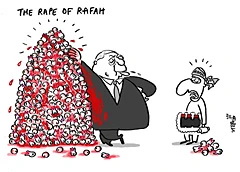
I’m speaking of the key. The keys to their homes that Palestinian refugees left behind when they were expelled from their country in 1948. Today you find 100,000 of these same refugees in what remains of their refugee camp in Rafah, where over the last three weeks Zionist forces have mounted the most brutal assault on them in the whole history of a 37-year-old occupation defined by wanton brutality.
The issue here is not whether the bad guys here will be sent, in due course, to hell. That’s a given. Our holy book tells us that for every oppressor a day will come, and history tells us just as assuredly that it has imperatives beyond the ability of any force to block.
Rather, the issue I’m raising today is how the Israeli entity has failed to wipe out the Palestinian people’s historical memory, that process by which societies and nations define their collective meaning, and without which they are helpless at making a future.
The hinge of that memory is known to Palestinians as the “Nakba,” a catastrophe so unique in scale, intent and consequence that it has entered the essential repertoire of every Palestinian’s consciousness, defining his inward preoccupations and identity. It’s uniqueness is anchored in the fact that nothing like it had ever happened to any other community in human history — that a people, hailing from across the ocean, would assault another, expel them en masse, and then rob them of their entire patrimony.
The Nakba bespeaks of a collective trauma. But to Palestinians the starting point to meaning is embodied in the concept of “Al-Awda,” (the Return), their lifeblood to a meditation on the future. The Nakba’s terminus, in other words, will be that day of grace when the native son reclaims his land.
You want to understand, truly understand, Palestinians — the mythic power of keys, as it were — then you begin by relating to their historical memory, deciphering their code of myths, and seeing how it has its own logic and its own grid of values. Above all, you may gain insight into how a “shahid,” or fallen patriot (pathetically translated into English as “martyr,” a term that is a function of the evolution of Christian iconography), would go on a suicide mission in pursuit of a cause he knows he’s not going to be around to see triumph.
History is helpless in the face of the mythic power of memory, transferred by Palestinians from generation to generation, to those who had not experienced it directly. Thus even a Palestinian child “remembers” how the greatest disaster than can befall man had befallen his people: The violent ruin of home and homeland. He “remembers” how, ever since 1948, they have been compelled to wander the earth, or dwell in refugee camps, in partial return to the manner of beasts. No ferocious rage equals that, for Palestinians, triggered by an assault on their concept of Al-Awda.
That’s what the leaders of the Israeli entity, true monsters by any definition, were doing in the Rafah region these last three weeks, assaulting a people because they have maintained their historical memory. But in this case you don’t blame the beast of prey for being a beast of prey. We blame the United States for making it all possible. We blame it for debasing, with such facile ease, the Palestinian’s right of return. We blame it because, over the years, no Israeli cruelty has been too gross to find apologia in the verbiage of the White House. To us, all this is a key issue.

