
Diamond. It is a word that grabs most people’s attention, associated as it is with wealth, sparkle and scintillating light and status. A symbol of permanence, even its original Greek name — adamus — means unconquerable, based on its best-known physical quality, hardness.
Heat diamond sufficiently in oxygen though and it will disappear as a cloud of carbon dioxide; tap a crystal gently in the right place, even accidentally, and it will split with unerring precision and predictability. Chemically, diamond is the same material that puts the lead in your pencil and the soot in the chimney: carbon. What makes a diamond different is the crystal structure — the way the carbon atoms link together in an atomic scaffolding or ‘lattice.’
With soot, there is no crystal structure; it is just an amorphous jumble of atoms. With graphite, the crystals are best visualized as hexagonal plates linked at the edges. Layers of them lie parallel to each other and slide over each other easily — much as playing cards slip over one another. That gives graphite its lubricating quality.
The crystal lattice in diamond is very different. The structure is a tight stacking of atoms linked by hugely powerful forces, inter-atomic bonds. This is where the strengths, industrial uses and weaknesses of diamond lie.
A diamond is hard, the hardest natural substance we know of. It is also incredibly tough — a slightly different but important property. Used appropriately, it can cut anything from metal to rock.
The hardness and toughness combined give diamond great strength and allow a minutely thin sliver of it to be shaped like a miniature knife blade, dozens of times sharper than steel. If a light beam is focused down the blade of a diamond scalpel for example, a line of light emerges from the cutting edge onto the surface below. This allows eye-surgeons to cut extremely cleanly with great precision.
It is largely diamond’s formidable hardness that has given it the unique position in industry it now holds. A crystal of diamond however is not equally hard in every direction; in each crystal there are six different directions of hardness and this characteristic is what allows diamond to cut other diamonds and ‘sharpen’ itself on rock drills. As the weaker directions break off, they leave only the hardest to do the work.
The only substance that will cut a diamond is a diamond. Laser ‘cutting’ is really vaporization — the heat of a laser turns the targeted area in the diamond to carbon dioxide.
Cutting with diamond is really the wrong word — abrade is more accurate — because the action of abrasion is what allows a steel blade impregnated with diamonds to ‘cut’ through a diamond or any other mineral. The tiny crystals of diamond in the blade are embedded in random directions — so some will present their hardest direction to the diamond being cut. As the diamonds wear down and the relatively soft steel of the blade wears away, new diamonds are exposed. These same characteristics of orientation, differential wear and hardness are what allow diamond tipped drills to grind their way through rock and extract the oil wealth of Saudi Arabia from thousands of meters below the ground.
Until the 1900’s, most oil wells were made using percussion drills — technology already in use by the Chinese in 1100 BC and still a very popular method of drilling for water. Essentially, a percussion drill is a pole with a heavy piece of metal on the bottom lifted and dropped repeatedly into a hole, gradually making it deeper. Natural diamonds were first used for drilling in about 1910 in hollow coring bits that cut doughnut-shaped holes to produce columns of rock for analysis. Diamonds were first used in drill-bits for oil wells in the early 1920s. Natural-diamond bits use industrial-grade stones that are crushed and processed to produce specific sizes and shapes
Throughout the 19th and 20th centuries, improvements in steel technology provided rotating drill bits that could cut through soft rocks. Even in soft rock, steel wears away rapidly, so today’s drills are often covered with inserts — or a complete outside layer — of tungsten carbide. This is more brittle than steel but has greater resistance to wear.
Even tougher is the tungsten carbide drill bit with synthetic diamonds added; but the hardest rocks can only be drilled with the help of real diamonds. As the tungsten-carbide is worn away at the cutting surface, worn diamond grains fall out and fresh grains become exposed.
In the early 1970s, two companies — one Swedish and the second American — developed a process of making synthetic diamonds. Thin circular layers of alternating carbon graphite and cobalt are stacked in small cans and pressed to 2 million pounds per square inch followed by heating to 1500 C for five minutes. To visualize this kind of pressure, imagine the new Queen Mary of 145,000 tons weight balanced on an area one metre square!
This replicates the conditions under which diamonds are formed in nature. About 120 kilometres under the earth’s crust, bubbles of methane or other carbon rich substances break down under the heat and pressure and the carbon becomes ready to crystallize in the liquid rock. Occasionally, as in the South African diamond fields, the magma is forced to the surface — the diamond crystallizing out on the journey and erupting or just oozing out. As it cools and weathers, the magma ‘blue ground’ breaks down and the diamond crystals become accessible.
Either process creates small crystals of synthetic diamond that bond together to become polycrystalline diamond compact (PDC). Unlike natural diamonds, the individual crystals are too small to carve into hard rock. Instead, PDC inserts are incorporated into the edges of drill bits to grind through the rock —? rather like extremely hard sandpaper. Diamond transformed the whole process of drilling for oil. It allowed much longer drill life and the development of steerable drills that start vertically but can be directed sideways to follow oil beds. Heat generated by cutting or abrading usually presents a problem. Diamond however dissipates heat more rapidly than any other substance. This means it needs less fluid cooling but gives the remarkable mineral several other uses.
Synthetic diamond wafers are used as heat sinks for expensive computer chips, dumping the heat generated by processing. The ability of diamond to dissipate heat and retain its strength took it to Venus. NASA wanted photos of the surface of Venus. The very high temperatures and atmospheric pressures on the surface, tons per square inch, meant that the metal Venus Lander spacecraft would crush in a few minutes and any glass lens either melt or shatter instantly. The solution was to make a window out of a single flawless crystal of diamond. The spacecraft vaporised but the diamond would still be there.
Its hardness has a more down to earth application in cameras as well. The blue ‘bloom’ on the more expensive lenses is in fact a micron-thick coating of vapour-deposited diamond, ultra thin but incredibly tough. Clever carbon: soot, diamond, graphite and even a fundamental element in the structure of the carbon-based life form that is reading this newspaper. You are alive because of it, yet breathe it as CO2 and it will kill you.
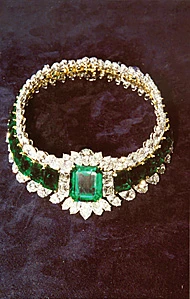
Oh! It’s nice in jewellery, too.