
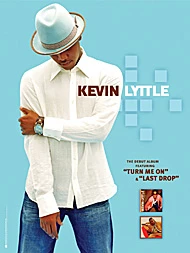
Atlantic recording artist Kevin Lyttle is proving anew one of music’s most important tenets: That just one person, with one daring idea, can convert an entire world full of listeners, fans, and musicians.
With its irrepressible beat, sweet melody, and a vocal performance that’s at once mellow, intense, and inviting, Kevin’s smash single, “Turn Me On” — recorded in a local studio on the island of St. Vincent — is the biggest soca hit to emerge from the Caribbean in 20 years. His eclectic and innovative fusion of music — traditional soca, American R&B, and Jamaican dancehall — set the entire West Indies on fire, and has boomed across dance floors worldwide in a phenomenal two-year run. For Kevin, 26, its massive and still-growing popularity has been a living lesson in music’s ability to unite and inspire.
“Everybody’s searching for something new; that’s the way of the world,” observes Lyttle. “I’m trying to be an ambassador for a music that’s been underestimated. My main focus is to take soca music where it’s never been before, so people can hear our music, our deep culture. It’s important for people to know where I come from.”
Since Kevin’s signing with Atlantic in the fall of 2003, “Turn Me On” has been on an absolute chart tear globally, and at this writing the single is nearing the million mark in international sales. It hit number two in the UK, where it stayed in the top 10 for a remarkable seven weeks.
Kevin was first inspired by music as a 7-year-old, sitting on his mother’s shoulders watching local Calypsonians competing for the title of Road March King in the yearly St. Vincent Carnival. At the same time, he cites the North American awards shows and televised performances — Michael Jackson’s moonwalk and “Billie Jean” in particular — that transfixed an entire generation of R&B and rap artists. “I’ve been influenced by all genres of music,” says Lyttle. “I have a love for every form of art.”
From his primary school days, his mother and uncle in voice, dance, and acting encouraged young Kevin. Lyttle wrote his first original song at 14, and participated in song competitions and cultural exchange programs, representing St. Vincent throughout the Caribbean.
“’Shower Me With Your Love’ by Surface was the first song I ever performed onstage,” Kevin recalls. “I was so nervous that I switched the verses around, but the girls were carrying on too much for anyone to notice. I worked for years, practicing my vocals and coaching myself from books to improve my range, trying to sing more like Michael Jackson or Stevie Wonder. I wanted to be able to represent myself onstage on that level.”
While working a variety of day jobs, Lyttle cut his first professional record without success. Nonetheless, encouraged by his workmates, in 2001 he brought two songs to local producer Adrian Bailey, one of which was “Turn Me On.” The session itself was deceptively easy. “I was done in two takes, less than an hour,” says Kevin. “No one had heard me sing in this range; on St. Vincent, some people thought it was Beres Hammond doing soca. That was really flattering.”
After a tremendous response in the St. Vincent Carnival, “Turn Me On” spread by radio and club play to neighboring Caribbean islands. With “Turn Me On” a confirmed smash in the Caribbean, Kevin then took the uncommon step of promoting the single throughout the US, Canada, and Europe. While legitimate copies were seeded to radio by Kevin’s management, even more downloaded copies of the tune were passed from fans to DJs, generating club and radio chart rankings in countries where the song had not been officially released. “I realized that this was my break, so I jumped on it. Everywhere they called me — in the Caribbean, New York, Toronto, London — I went to represent it,” Lyttle says.
In two years, the song has proven its appeal to a cross-cultural audience, and proven soca’s potential at the same time. “The song’s foundation was soca, but I meant for it to have other elements of R&B and reggae, as well as an exotic vibe,” says Kevin. “That way, I could keep it hardcore for the Caribbean audience, but the worldwide audience could grasp it also.” The Caribbean is a thorough ethnic mix, Kevin notes, with obvious pride. “Chinese, Japanese, Indians, blacks, whites, Spanish, are all there. “
While this suggests that the song’s groundbreaking fusion was inevitable, it’s clear that Kevin’s boldly progressive approach has helped bring a new momentum to soca. “You don’t have to limit the music. You should explore it,” he says.