
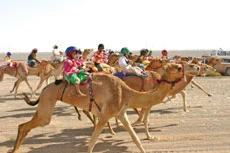
IN the far south of that marvelous desert called the Wahaiba Sands, in the Sultanate of Oman, is the small town of Al-Hij. It's an unremarkable small town, home to the nomads of Oman, the Bedouin, who are increasingly turning to a settled life. Isolated by the Arabian Sea to the south and by hundreds of kilometers of desert in other directions, Al-Hij fits the description "in the back of beyond". Despite or perhaps because of its isolation, Al-Hij occasionally hosts what must be a quintessential part of life in rural Oman — camel racing.
We set off on what would be an all-day journey from the northern edge of the Wahaiba Sands. The northern end of the desert has a number of small oasis towns clinging to the desert's edge, swaths of green contrasting with the gold of the surrounding dunes. From the top of the dunes the leaves of the date trees present an impenetrable canopy; below them a microclimate enables papaya, banana and lime to be grown.
The Wahaiba Sands look like a carelessly dropped cloth of gold. Our route away from the town took us past scattered camps of Bedouin families who still love the open desert. Most of them had a small flock of goats or sheep, somehow managing to find the food that our eyes missed.
Making a route through empty desert needs speed and a certain amount of bravado to avoid becoming bogged down in the soft sand. On those occasions when we stopped and got out of the vehicles to take a break from the journey we experienced silence. Not the type of silence found in any town where it simply means a reduction of noise. Here silence is simply that — absolutely no sound at all. It provided an extraordinary sense of calm and peace.
We camped overnight close to the race track, and the desert dawn woke me the next morning for the day's races. Below us I saw what at first I assumed was a mirage; a mist disappearing into the distance. But this was a real mist that had come inland from the sea and now was being burned up by the heat of the sun.
Racing was already under way as we arrived at the race track and a dozen or so camels galloped along, pursued by a cloud of dust. In the cloud dozens of 4x4 pick up trucks were following the camels with horns blaring and passengers shouting as if, with the noise of revving engines behind her, a camel needed any extra incentive to get away as quickly as possible.
At the starting line camels for the next race were sitting calmly, covered in blankets, ruminating over their winning chances. Nearby a group of jockeys fidgeted. One of them, Ali Al-Wahaibi, said that since he had been telling camels what to do for all of his seven years, he knew he could tell his mount to go just that little bit faster than the others. I supposed each of the other riders would have the same confidence in their abilities.
The return of the dust cloud broke the calm. What seemed like a good dozen men jumped from each of the pickups and the preparations for the next race started. The starting official went from camel to camel with a Qur'an so that each owner could testify on it as to the age and origin of his animal. Tagging along with the starter was a man with a can of red spray paint. Finally the jockeys were mounted, the camels were held at the start and finally set off.
The pick-ups once again gave chase. I leaped into the nearest one and we shot off bumping over the rough ground parallel to the smooth race circuit while we all somehow managed to stay upright in the back. Remarkably the driver managed to maneuver through the mass of vehicles without accident to arrive close to his favorite camel. My fellow passengers shouted instructions to the rider alongside while the jockey and camel concentrated on the finishing line ahead.
The sight was spectacular. On either side of the line were several large goat hair tents and glittering under their shade were flashes of gold and silver. In the women's tent bedecked and bejeweled women sparkled as they sat or stood watching the camels gallop past, dramatic Golden Bedouin face masks accentuating their kohl-painted eyes. From the men's tent the silver Omani daggers glittered in the sunlight.
The day's racing had drawn a crowd from a wide area. For today's events the racing camels could only come from Al-Wosta, the central region in Oman. I was told the jockeys were not professional but came from families who owned camels around Al-Hij.
Each of the six races was between three and six km in length. Ali ibn Salim Al-Amri told me that a typical age for the camels was two to three years and added it was only female camels that were raced since they were far better behaved.
Standing around the finishing line it became obvious that for many people the chance to meet with friends was a main draw of the races. Small groups formed and separated; hands were held and noses touched in that characteristic Bedouin form of greeting. The distances some people had traveled were greater than our own modest effort. Sheikh Abdullah Mabkhoot Al-Janaibi and his family had come some 300 km along the Omani coastline.
I was surprised that each of the first three camels had a blood sample taken. Said Ali Al-Mughari, who had several camels racing, explained that such was the increase in value of a winning camel that in the past there had been cases of camels being given stimulants to make them race faster. I asked him how much he would want for a winning camel. Like any canny owner he wouldn't say, but explained that a sought-after winner will fetch $300,000.
Tradition still had a firm place in the ceremonies after a race. In what could be taken for the winners' enclosure each of the first three camels in the race was anointed with a mix of saffron and henna by a young Bedouin woman, to bring them further success.
When the morning's events drew to a close. Sheikh Hamoud Nasser Al-Hashmi, the governor of the region, distributed prizes to the winners; a small token against the newly increased value of their successful animal. Perhaps most surprising of all was the open invitation to anyone to attend a feast in the shade of another tent. There were large trays piled high with rice and meat waiting for hundreds of race goers to eat their fill.
One more surprise was to unfold as we traveled back along the modern blacktop road to Muscat.
In a reversal of roles, we were overtaken by six camels, not ridden by a confident young jockey but sitting in cushioned luxury in the back of a three-ton truck.