ALKHOBAR, 22 July 2004 — Horses are a vital part of the heritage of Saudi Arabia. Unfortunately, during the decades when the Kingdom was striving toward urbanization, the value and importance of the horse was ignored for a time. But in the last decade, efforts have been made to restore these magnificent creatures to their rightful place, both culturally and socially.
The bedouins of this desert land lived and died with their horses. Horses gave a tribe prestige, worth and honor. On the Arabian Peninsula, the horse was more than a beast of burden. Since the earliest times, Arabians were valued for their beauty, endurance, speed and agility.
While the bedouin always understood the importance of the Arabian horse, it was not until the 18th century that the horses of the Arab world began to be known in the West. The Arabian provided the speed in the breed that is now called the English thoroughbred. In fact, of the hundred or so breeds of horse today, most have been enhanced through an infusion of Arabian blood.
Thus, it was a pity that for many years the children of Saudi Arabia valued their bicycles more than the nation’s splendid horses. There was a time not long ago when Saudi children only saw horses in amusement parks or near beach resorts. The poor creatures found at those recreation areas were poor relations of the bedouin’s Arabians.
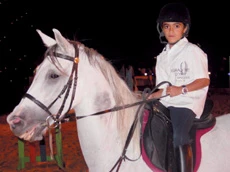
But times have changed and a new generation of Saudi children are learning to love the animals that were the pride of their forefathers. Muhammad K. Al-Abdulkarim is just nine years old but this is his fourth year on horseback. He has already mastered the basics of the equestrian arts and is now taking hunter classes. Muhammad is not only putting his mounts through their paces, but this young rider and his horses have moved on to jumping fences more than a meter and a half high.
“I love my horses. They don’t always do what I want but I have to try and teach them not to be afraid to jump,” said Muhammad. “Myself, I am not afraid of the fences. I hold on tight and usually going over the fences is just like flying. It’s very easy.”
It’s very easy because Muhammad has been taught by experienced riding instructors over the years. The boy is at the stables and riding school every afternoon and is generally on horseback at least an hour or two daily. Even though he is slight in stature Muhammad’s command of the powerful animals is impressive. He has recently become skilled enough to begin entering local competitions.
“I like competing because it’s exciting and I get to see how well I can do against other riders,” explained Muhammad. “My father always claps for me and encourages me. I wish more boys would take up riding so we could have bigger competitions like the ones in England and the United States.”
Watching his son casually riding around the stable yard is fine, but Khalid A. Al-Abdulkarim admitted that it can be nearly heart stopping when the boy takes the high jumps. Seeing the young rider thrown is even more of a concern.
“My father gets worried when he hears that I fell or that the horse stumbled,” said Muhammad, as his father nodded in agreement. “We learn how to fall, so while I don’t like it, it’s not as dangerous as it sounds. Sometimes the horse decides not to take the fence and he might even rear up on his back legs. That is when I have to be strong and make him listen. My instructor is always there and catches the stallion’s bridle quickly if I am having a problem. Yesterday I fell down with the horse and as a penalty today I had to bring cake for all the other students. That was okay.”
Horseback riding is a lot like life. The most successful people aren’t the ones who never fall. It’s the ones who mount up again and again who are the achievers. If Muhammad can take to heart the lessons learned on horseback, then a bright future is certainly waiting for him.