
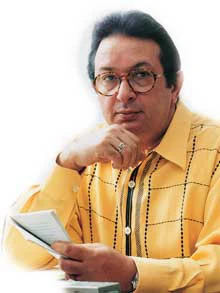
NOUR Al-Shareef makes you feel he is a political artist and he admits that. However he refuses to be identified with a particular group because with such a commitment he would lose the freedom to move and would chain him to a party’s policies. His fame results from the cinema and television but little do people know that he has presented a number of plays that have been described as “serious” but which have not been recorded. Those that were recorded by TV are shown after people have gone to sleep.
We saw you in the play “Ya Ghoula Einek Hamra” (Oh monster, your eye is red) on TV. Why didn’t you broadcast your play?
I have 4 plays that have been broadcast on TV at 4 a.m. while people sleep. I’m sad that a lot of my plays were not recorded. We’ve become besieged in the Arab world with the low comedy theater.
Why is this happening?
I don’t understand. I remember in the 80s I presented “An Evening with Laughter”, which I directed and co-produced with Ali Salem, a playwright. It is 3 single-act plays and the maximum price of the ticket was five pounds, which was the price of national theater at the time. Salem and I used to get 10 pounds a day while Ahmad Bedeir, another famous comedian would get 50. I thought we would profit if we sold the play to satellite channels, but unfortunately all the Arab chanels refused to buy it. I’m sad that my theater history that is full of important areas isn’t recorded and that which is recorded has rarely been broadcast.
Is this an attitude toward you as an actor?
Not at all. This is what happens with any serious play. I hope that TV theater will prove to be only a window for theater production and that it will play a role in the audiences getting used to serious plays, not just humor.
In light of the cinema and TV do you see the theater as ‘losing card’?
On the contrary, theater is the only art that will resist modern technology. However what remains is the skill for dealing with this issue appropriately because theater is still centered on a flesh and blood actor in front of an audience, all gathered in one place. It is a democratic art that tackles reality and I don’t mean democratic as in freedom but rather in opening the minds of the audience to encounter new ideas in which you’ve an opinion about. However the problems of theater are illustrated in those active in it and their inability to innovate theater styles that go along with the general development of taste for the viewer.
You demanded that actors involved in politics should retire; why?
I meant that any actor who has a lot of popularity and has decided to go into politics must choose between the two: either to stay as an actor and express his opinions through his works or to become a professional politician and to leave acting since he’ll lose at the end. If he presents a political work he will have to lie to the audience that loved him because politics call for lying and this will lose him popularity as an actor.
But many people think of you a political actor.
Yes but I have the freedom to deal with issues. However if I became a member of the national council or responsible for one of the parties I would lose my freedom because if I ever found that my party was wrong I’d tell the people.
Do you think that an actor should have a particular political direction or that he should be a ‘politicized’ actor?
It’s better that he has a political direction, one that he believes in, far from any party of course. However an actor must at least have a minimal political knowledge in that he must have been aware and conscious enough to defend his true values whatever they may be.
You’re a lover of history and politics. Did you ever want to become a historian had you not been an actor?
No. I could have become a teacher because I love teaching to convey my experience to people. It was among the best stages of my life when I was a lecturer at Theater Arts Institution and when I presented my experience to a group of opera lovers. I also could have succeeded in advertising or as fashion and jewelry designer, for I’ve often designed my wife’s clothes — the actress Bousi — in her movies and the rings of my daughters Sara and May.
We want to talk about the experience of an actor becoming a TV presenter.
I am the youngest actor to work as a presenter. When I was 25 years old I presented a TV program titled “Check out your Luck”. Three years ago I presented a program on Dream Channel — which I really don’t consider as a program — it’s more of a study I prepared. I was presenting a study of cinema movies and a re-evaluation of the most prominent of figures in cinema history who did not get the recognition and appreciation they deserved. I’m very happy with this experience.
You are now shooting a new soap opera/series for the new writer Mustafa Muhram who wrote “Al-Hajj Mutwali”; (a controversial series that showed the life of a man who takes 4 wives and lives happily) is the story similar to it?
No. The series is about middle age crisis of men and women. It’s a stage of psychological and biological changes. We are presenting an illustration of it with the story of a good man who has a simple family and when he reaches middle age, he finds out that at the age of 55 years, he’s achieved none of his dreams.